
Table of Contents
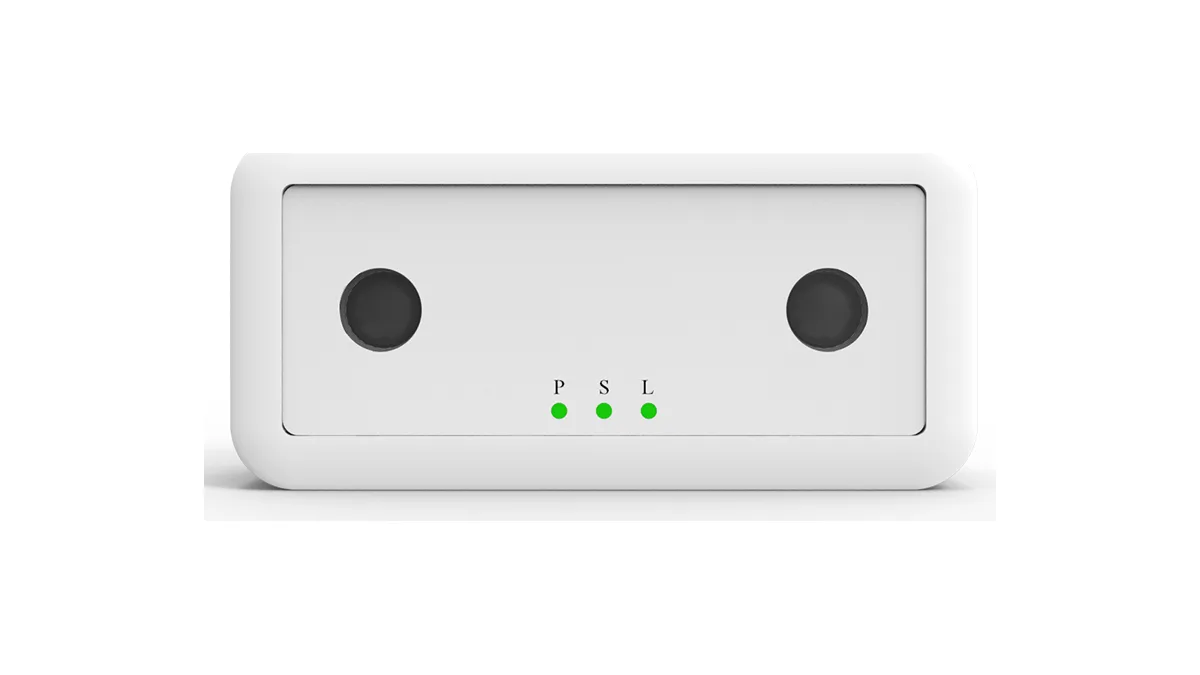
A retail people counter pays back when the visitor data leads to decisions that lift conversion rate or cut wasted labor, and the extra gross profit exceeds the cost of the system. Because a store's point-of-sale system already records sales and transactions, the people counter adds the one missing number, visitors, and turns a vague slow day into a measurable conversion problem.
This article shows the formula behind people counter ROI, works through five store types with clearly stated assumptions, and gives a simple break-even test you can run with your own numbers before you ask for a quotation.
The formula behind people counter ROI
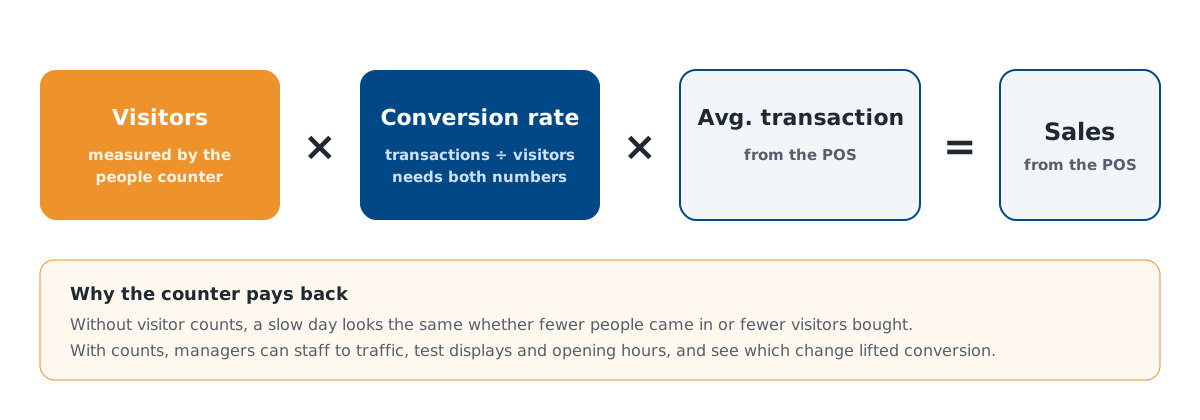
Every retail sale can be broken down into three numbers:
Sales = Visitors × Conversion rate × Average transaction value
Conversion rate is the share of visitors who buy: transactions divided by visitors. Without a people counter, a store can see that sales fell, but cannot tell whether fewer people came in or fewer visitors bought. Those two problems need opposite fixes. Fewer visitors calls for marketing, window displays or a look at opening hours; lower conversion calls for staffing, product availability, queue management or layout changes.
The return from a retail people counter comes from the gross profit on extra sales, plus any labor saved:
Monthly benefit = Monthly visitors × Conversion uplift × Average transaction value × Gross margin + Labor savings
A conversion uplift of one percentage point means, for example, moving from 20 percent to 21 percent of visitors buying. That sounds small, but it applies to every visitor, every day.
Where the conversion uplift comes from
- Staffing to traffic. Hourly visitor counts show when the store is understaffed. Moving staff hours from quiet mornings to busy afternoons is the most common source of uplift, and it often costs nothing extra.
- Queue management. Visitors who walk out of a long checkout queue are lost sales. Counting and occupancy data trigger an extra till before the queue gets long.
- Testing displays and promotions. Visitor and conversion rates before and after a window or promotion change show whether it worked, instead of guessing from sales alone.
- Opening hours. Traffic by hour shows whether an early opening or late closing earns its staff cost.
- Store comparisons. In a chain, conversion by store highlights the managers and layouts that perform best, so their practices can be copied.
For more traffic-side tactics, see our article on how to increase footfall in retail, and for the definitions of each metric, our retail metrics glossary.
Five worked examples
The examples below use round, illustrative assumptions for each store type, not results from specific customers. Visitors are per day, with 30 trading days per month. Replace the numbers with your own store data.
| Store type | Visitors per day | Conversion rate | Average transaction | Gross margin | Assumed uplift | Extra gross profit per month | Extra gross profit per year |
|---|---|---|---|---|---|---|---|
| Fashion boutique | 300 | 20% | USD 60 | 55% | +1.0 point (20% → 21%) | USD 2,970 | USD 35,640 |
| Convenience store | 900 | 85% | USD 8 | 30% | +0.5 point, plus 1 staff hour per day saved at USD 15 | USD 774 | USD 9,288 |
| Department store, 4 entrances | 4,000 | 25% | USD 45 | 40% | +0.5 point | USD 10,800 | USD 129,600 |
| Specialty chain, 20 stores | 250 per store | 15% | USD 35 | 45% | +0.5 point | USD 591 per store, USD 11,813 in total | USD 141,750 in total |
| Furniture showroom | 60 | 5% | USD 1,800 | 35% | +0.5 point | USD 5,670 | USD 68,040 |
1. Fashion boutique
A boutique with 300 visitors a day and two staff on the floor has a classic staffing problem: the afternoon peak gets the same coverage as the quiet morning. Hourly counts show the peak, the shift pattern changes, and conversion rises by one percentage point. That is 90 extra transactions a month and about USD 2,970 of extra gross profit.
2. Convenience store
Convenience stores already convert most visitors, so the value of a people counter lies elsewhere: matching staff hours to traffic and preventing walk-outs at the till. In the example, one staff hour a day saved in quiet periods and a half-point conversion gain from shorter queues add up to about USD 774 a month. The return is smaller, so a low-cost counter and a simple setup matter most.
3. Department store with four entrances
High traffic makes even a small uplift valuable: half a point on 120,000 visitors a month is 600 extra transactions. Accurate counting at wide, busy entrances is essential here, because the data drives staffing across several floors. Entrance counts can be combined with zone counts to see which departments attract visitors but fail to convert.
4. Specialty chain with 20 stores
Per store, the gain is modest, about USD 591 a month. Across 20 stores it reaches more than USD 140,000 a year, and head office gains a comparable conversion figure for every store. The chain can rank stores, spot underperformers early and roll out what works in the best ones.
5. Furniture showroom
Few visitors, high ticket value: half a point of conversion means nine extra sales a month worth about USD 5,670 in gross profit. Showrooms also use counts to judge marketing campaigns, because a campaign that brings visitors who do not buy is easy to spot.
The break-even test: how many extra sales do you need?
Instead of starting from a guess about uplift, turn the question around: how many extra sales per month does the store need to recover each USD 1,000 of yearly system cost? The answer is USD 1,000 divided by 12 months, divided by the gross profit per sale.
| Store type | Gross profit per sale | Extra sales per month to recover USD 1,000 a year | Equivalent conversion uplift |
|---|---|---|---|
| Fashion boutique | USD 33 | 2.5 | +0.03 points |
| Convenience store | USD 2.40 | 34.7 | +0.13 points |
| Department store | USD 18 | 4.6 | +0.004 points |
| Specialty store (one of 20) | USD 15.75 | 5.3 | +0.07 points |
| Furniture showroom | USD 630 | 0.13 (about one sale every eight months) | +0.007 points |
Multiply by your total yearly cost, including hardware spread over its life, installation, software and support, to get the number of extra sales needed. In most store types, the required uplift is a fraction of a percentage point, far below what better staffing alone usually achieves. The exception is low-margin, high-conversion formats such as convenience stores, where labor savings and a low-cost system carry the business case.
What can break the business case
- Inaccurate counts. If the counter misses 10 percent of visitors, conversion is overstated by about 11 percent, and real changes are hidden in the noise. Wide, busy entrances need overhead 3D counters; see our comparison of infrared, camera and 3D people counters.
- Staff in the counts. Employees walking in and out inflate visitors. Use a staff entrance, schedule-based filtering or staff exclusion.
- Data nobody uses. The return only appears when someone reviews conversion weekly and changes schedules or displays. Assign an owner before installation.
- No baseline. Collect four to eight weeks of counts before changing anything, so the uplift can be measured against a fair comparison.
- Disconnected data. Visitor counts must be lined up with POS transactions by store and hour. Check the counter's API and export options; our people counting API guide shows typical integrations.
How to measure the uplift fairly
- Install counters and run them for a baseline period without changing anything.
- Validate accuracy with a manual count of one busy hour.
- Change one thing at a time, for example the afternoon staffing plan.
- Compare conversion with the baseline, and where possible with similar stores that did not change, to remove seasonal effects.
- Repeat with the next change, and keep the ones that work.
Where Pyroglaux fits
The Pyroglaux PCBot-R40 is a 3D stereo people counter for store and mall entrances. The manufacturer specifies 98 percent or better accuracy, including people walking less than 20 centimeters apart, and the sensor filters bags and luggage, runs on Power over Ethernet, keeps data during network outages and offers an SDK for integration with POS and BI systems. More models are listed under smart counting, and our footfall counter buyer's guide covers the selection process. Send us your store layout, entrance widths and the systems you want to connect, and we will help you build the business case with your own numbers.
Frequently Asked Questions
How long does a retail people counter take to pay back?
It depends on traffic, transaction value and margin. In the worked examples in this article, the extra sales needed to recover each USD 1,000 of yearly system cost range from less than one sale a year in a furniture showroom to about 35 extra sales a month in a convenience store. Use your own numbers in the formula to estimate payback for your store.
Does a people counter increase sales by itself?
No. A people counter measures visitors and makes conversion rate visible. Sales grow when managers act on the data, for example by matching staff to traffic, testing window displays or adjusting opening hours.
What is a good retail conversion rate?
There is no single benchmark. Conversion rates vary widely by category: convenience stores convert most visitors, while furniture and car showrooms convert a small share. Compare each store with its own history and with similar stores in your chain.
How accurate must a retail people counter be?
Accurate enough that changes in conversion rate are real. A counter that misses 10 percent of visitors overstates conversion by about 11 percent. For conversion analysis, choose an overhead 3D counter and validate it against a manual count.
Should staff be excluded from visitor counts?
Yes, where possible. Staff entering and leaving can inflate visitor numbers, especially in small stores. Use a staff-only entrance, schedule-based filtering or a counter with staff exclusion features.
Planning a people counting project?
Tell us the site type, entrance widths and mounting height. We reply with a model recommendation and a quotation within one working day.
Get a quote