
Table of Contents
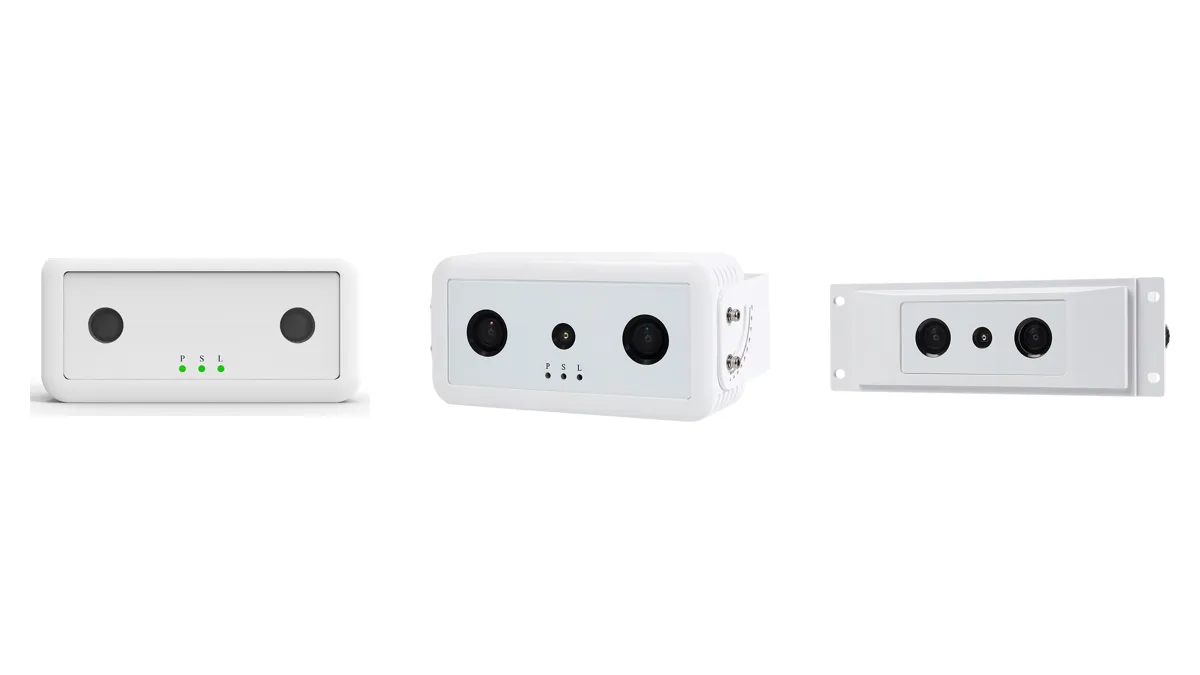
For narrow, quiet doors an infrared people counter is usually enough; for busy or wide entrances where people walk side by side, choose an overhead 3D stereo people counter; and use 2D camera analytics when you want zone and occupancy data from cameras you already own. The right choice depends on entrance width, traffic, mounting height, privacy rules and what you plan to do with the data.
This guide explains how the four main people counting technologies work, where each one fails, and how they compare on accuracy, installation, privacy and cost. At the end you will find a recommendation for the most common types of sites.
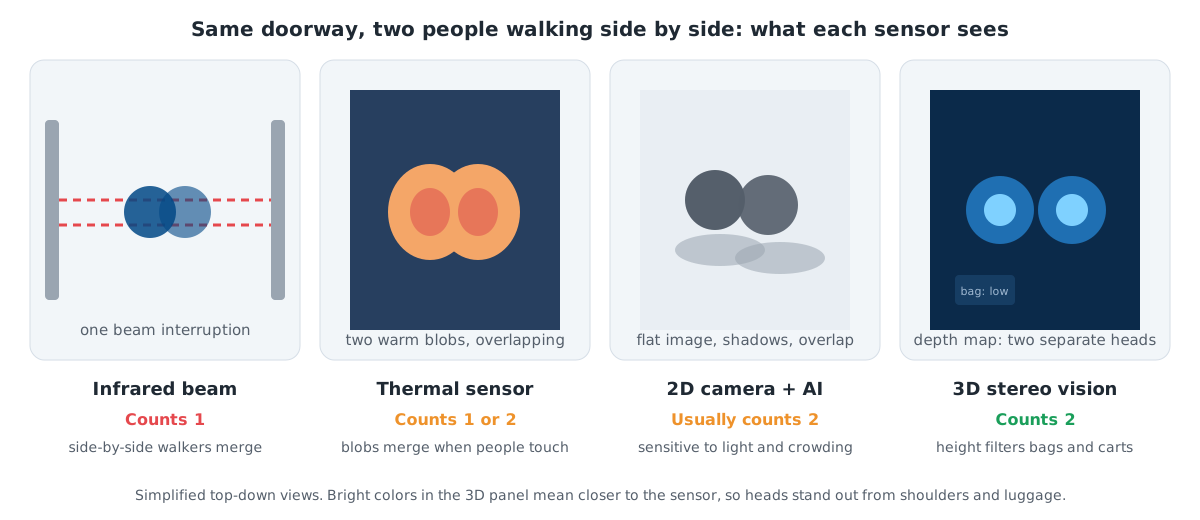
Infrared people counters
The term infrared people counter covers two different devices, and buyers often confuse them.
Infrared beam counters
An infrared beam counter is mounted on the side of a door frame. A transmitter sends an invisible beam to a receiver or reflector on the opposite side, and every time the beam is interrupted, the counter adds one. Models with two beams side by side can tell direction, so they count in and out separately. Infrared beam counters are inexpensive, run on batteries for months, and need no ceiling work.
The weakness is simple geometry: two people walking side by side interrupt the beam once, and a shopping bag swinging through the beam can count as a person. Accuracy drops as entrances get wider and busier. Infrared beams are a good fit for doors narrower than about 1.5 meters with light traffic, and a poor fit for mall entrances, stations or any door where groups walk through together.
Thermal (passive infrared) counters
A thermal counter is mounted on the ceiling and looks down with a low-resolution heat sensor. People appear as warm blobs against a cooler floor, and software tracks the blobs across a line. Thermal sensors work in darkness, capture no identifiable images, and handle moderate traffic better than beams. They struggle when people touch or walk very close together, because the warm blobs merge, and when the floor or the air is close to body temperature, for example at an open entrance on a hot day.
2D camera people counters
A 2D camera people counter uses a normal video image and an AI model that detects people or heads. The camera may be a dedicated overhead counting camera or an existing CCTV camera connected to analytics software or an AI edge box.
Modern AI makes 2D counting far better than older motion-based video counters, and a camera can deliver more than entrance counts: zone occupancy, queue length, dwell time and heat maps. The limitations come from the flat image. Shadows, reflections on shiny floors and sudden light changes can confuse the model, and angled CCTV cameras see people hiding behind each other. 2D cameras are also more likely to raise privacy questions, because they see faces unless they are mounted straight down.
3D stereo people counters
A 3D stereo people counter has two lenses a few centimeters apart, like human eyes. By comparing the two images, the device calculates a depth map: the distance from the sensor to every point below it. Heads are the points closest to the sensor, so the counter finds and tracks heads by height rather than by appearance.
Depth is what makes 3D counters accurate in crowds. Two people walking shoulder to shoulder are two separate heads. A child can be separated from an adult by height, a shopping cart or suitcase is ignored because it is not at head height, and shadows on the floor do not matter. Because counting runs on depth data on the device, 3D counters can produce counts without storing identifiable images. Time-of-flight (ToF) sensors reach a similar result by measuring how long infrared light takes to bounce back, with good performance indoors and some sensitivity to strong sunlight.
The trade-offs are cost and installation: 3D counters cost more than beams and must be mounted overhead, usually connected by an Ethernet cable with Power over Ethernet. For the main entrance of a store or mall, that cost is usually justified, because every conversion and staffing figure depends on the visitor count. Our guide to the challenges associated with people counting shows which errors each technology is prone to.
Side-by-side comparison
| Factor | Infrared beam | Thermal overhead | 2D camera + AI | 3D stereo |
|---|---|---|---|---|
| Accuracy at quiet, narrow doors | Good | Good | Good | Very good |
| Accuracy with groups and crowds | Poor | Fair | Fair to good | Very good |
| Entrance width per sensor | Narrow | Small to medium | Medium to wide | Medium to wide; several sensors can be joined for very wide entrances |
| Adult and child separation | No | Limited | Limited | Yes, by height |
| Ignores carts, bags, luggage | No | Partly | Partly | Yes |
| Lighting sensitivity | Low (direct sunlight can blind some models) | Low; sensitive to heat | High | Low to medium |
| Privacy | No images | No identifiable images | Video images | Depth data; images not required |
| Installation | Door frame, battery or cable | Ceiling | Ceiling or existing camera | Ceiling, usually PoE |
| Extra analytics | In/out counts only | Counts, basic occupancy | Occupancy, queues, dwell, heat maps | Counts, occupancy, dwell, flow direction |
| Relative hardware cost | Lowest | Low to medium | Medium (lower if cameras exist) | Medium to high |
Which people counter for which site?
Small shops and offices with one narrow door
An infrared people counter with two beams gives reliable in and out counts at the lowest cost, as long as people pass one at a time. Upgrade to an overhead sensor if you plan to calculate conversion rate precisely, because a few percent of undercounting changes the result.
Fashion, electronics and specialty retail
A 3D stereo counter at the entrance gives accurate visitor counts for conversion rate, separates children and filters out strollers and bags. The PCBot-R40 is one example: the manufacturer specifies 98 percent or better accuracy, it is powered over Ethernet, and it can also measure dwell time and flow inside the store.
Shopping malls, department stores and supermarkets
Wide entrances with heavy two-way traffic need 3D stereo counters, often several sensors joined across one entrance. Combine them with 2D analytics on existing CCTV cameras for zone occupancy, queues and tenant-level heat maps.
Buses, trains and stations
Doors on vehicles need wide-angle 3D sensors with infrared illumination and a door-open signal input. Read our guides to automatic passenger counting for rail and to passenger flow counters for buses.
Museums, libraries and public venues
Thermal or 3D counters work well where visitors expect privacy and only occupancy and totals are needed. See our article on privacy-safe visitor counting.
Workplaces and meeting rooms
Occupancy sensors at desk or room level answer different questions from entrance counters. Our desk occupancy sensor guide covers that use case.
Five questions to ask before you buy
- How wide is each entrance, and how high is the ceiling? These two numbers decide the sensor type and how many sensors you need.
- How busy is the entrance at peak times? Groups and parallel traffic rule out beams.
- What will the data be used for? Conversion rate and staffing need high entrance accuracy; occupancy dashboards can tolerate more error.
- Where does the data need to go? Check for local storage during network outages, an API or SDK, and compatibility with your POS or BI system.
- How will accuracy be checked? Agree a manual or video reference count at handover, and repeat it once a quarter.
For a full walk-through of the buying process, read our footfall counter buyer's guide. If you send us your entrance widths, ceiling heights and traffic levels, we will recommend the counter type and the number of sensors for each door.
Frequently Asked Questions
Are infrared people counters accurate?
Infrared beam counters are accurate enough for narrow doors where people pass one at a time, such as a small shop or an office corridor. They undercount when people walk side by side or in groups, so wide or busy entrances need an overhead camera-based or 3D sensor.
Is a 3D people counter a camera?
A 3D stereo counter contains two image sensors, but the counting is based on the depth map calculated from them. Most models process everything on the device and output counts only; some can also stream video for installation and maintenance.
Which people counter is best for GDPR?
Infrared beams and thermal sensors capture no identifiable images. 3D stereo counters that count from depth data and do not store images are also privacy-friendly. Whatever you choose, check the configuration, retention settings and local rules, and display signage where required.
Can I use my existing CCTV cameras for people counting?
Yes, with video analytics software or an AI edge box. CCTV cameras are usually mounted at an angle, which causes occlusion, so accuracy is lower than a dedicated overhead counter at busy entrances. CCTV analytics works well for zone occupancy and queue estimates.
How high should a people counter be mounted?
It depends on the model and lens. Overhead 3D counters typically cover mounting heights from about 2.2 to 6 meters, and wide-angle versions work from lower ceilings. The higher the mounting, the wider the area covered per sensor.
Planning a people counting project?
Tell us the site type, entrance widths and mounting height. We reply with a model recommendation and a quotation within one working day.
Get a quote