



How to Increase Footfall in Retail: 12 Data-Driven Tactics
2026-08-29 16:34How to increase footfall in retail comes down to four levers: give people a reason to walk in, remove the friction at the door, hold attention once inside, and schedule staff against the hours traffic actually arrives. Every tactic below attaches to one of those four levers, and every tactic is measurable.
Most guides on how to increase footfall in retail stop at a tactic list. The reason those programmes disappoint is not the tactics. The reason is that stores run several tactics at once, without a baseline count, and cannot afterwards say which tactic moved the number. Measurement comes first.
Why Does Footfall Alone Not Increase Revenue?
Retail store traffic is only the first of four terms that multiply into revenue. The chain runs: footfall x capture rate x conversion rate x average transaction value. Lifting footfall while conversion falls leaves revenue flat.
A promotion that lifts retail store traffic 30% with no extra staff usually lengthens queues, lowers conversion, and cancels the gain. Anyone asking how to increase footfall in retail profitably has to watch the second and third terms at the same time.
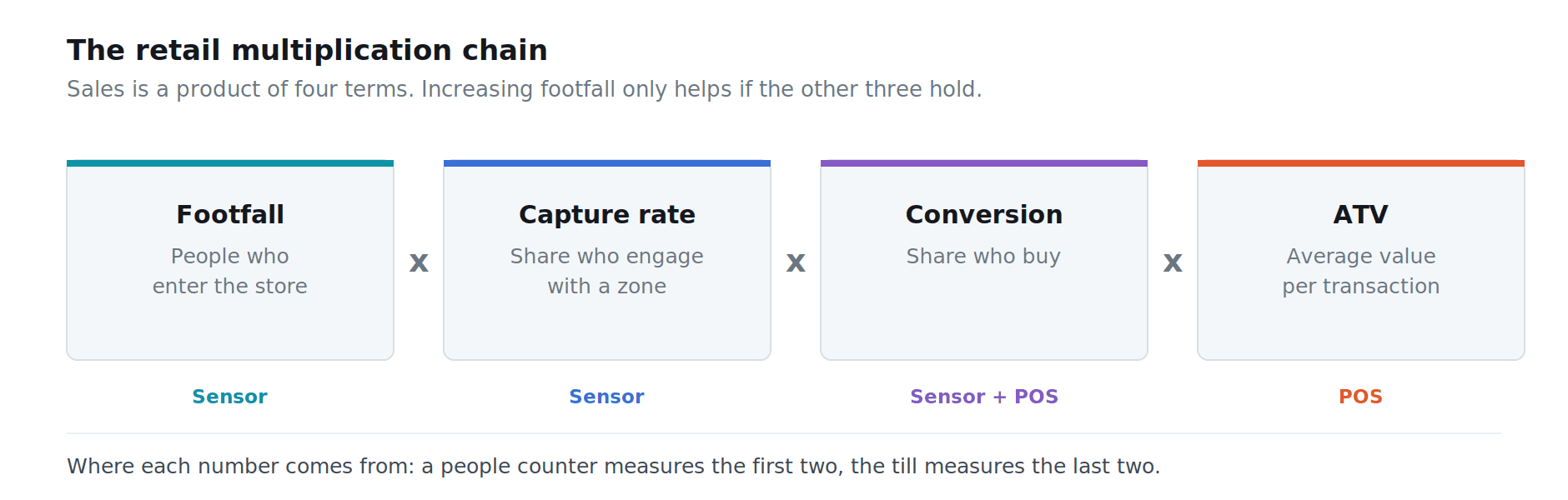
Where each number comes from matters for tooling. A people counter measures footfall and capture rate. The till measures conversion and average transaction value. Neither instrument can produce the full chain alone.
What Conversion Rate Should a Store Expect?
Conversion rate equals transactions divided by visitors, multiplied by 100, and the healthy range depends entirely on store format. Comparing a fashion boutique against a convenience store produces a meaningless verdict.
| Store format | Typical range | Strong performance |
|---|---|---|
| Grocery and convenience | 40-60% | 65%+ |
| Big-box and department | 20-30% | 35%+ |
| Apparel and fashion | 15-25% | 30%+ |
| Specialty retail | 10-20% | 25%+ |
| Electronics | 8-15% | 20%+ |
| Luxury and high-end | 5-12% | 15%+ |
Source: sector ranges published by Dor, reproduced in the TruRating retail conversion rate guide (2026). Directional vendor benchmarks rather than formal standards; the overall brick-and-mortar average sits near 20% per Traf-Sys.
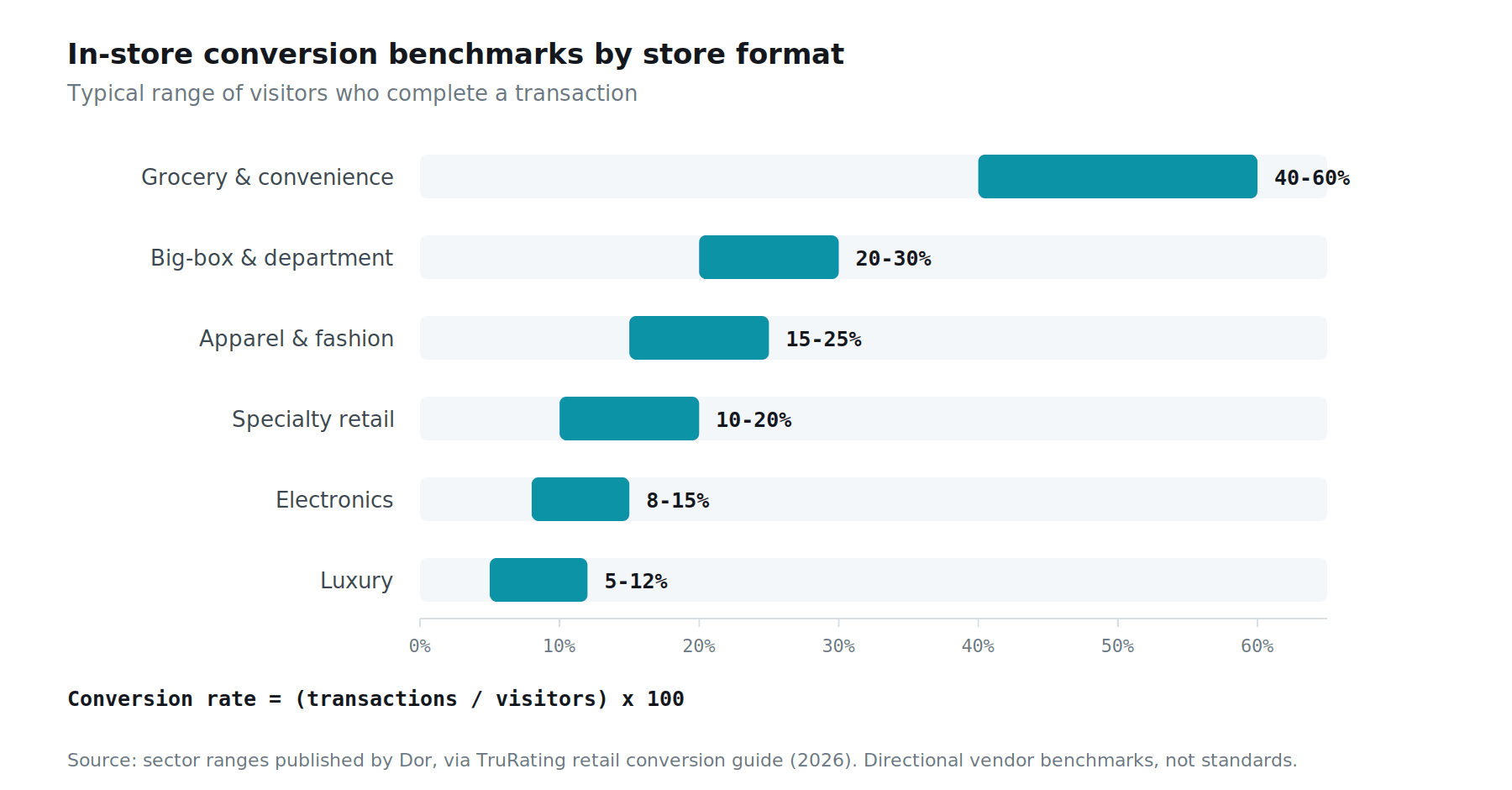
Use the table as a sanity check, then abandon the table in favour of your own retail footfall data. A store's own trailing 12 weeks, compared against the same weekday, is a far better benchmark than any published range.
How to Increase Footfall in Retail: 12 Tactics
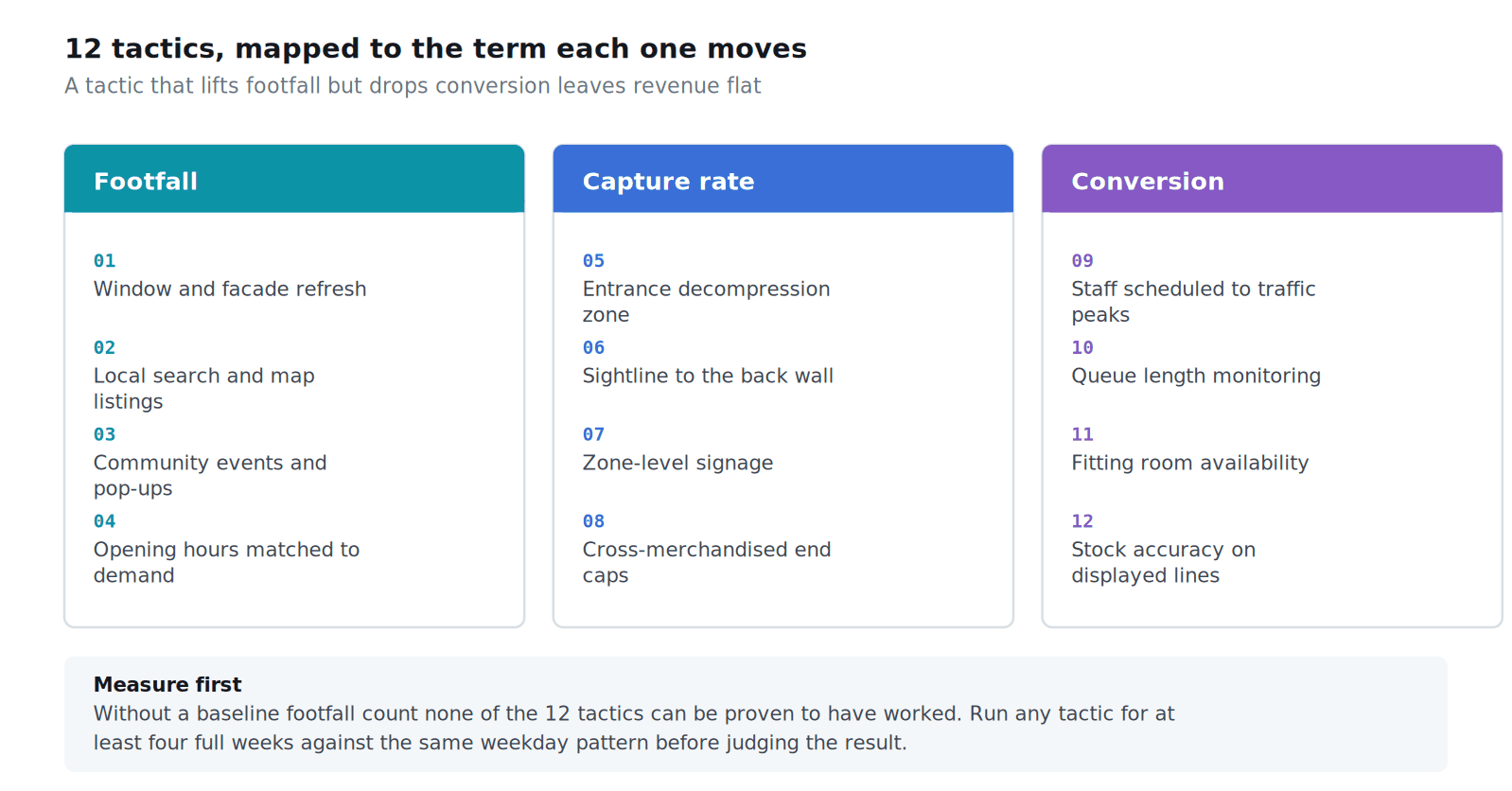
The 12 tactics below are grouped by which of the first three terms each one moves. Average transaction value is set by pricing, range and upsell rather than by store traffic, so ATV sits outside this list and is managed from the till side. Running one tactic from each group at once is safer than running four footfall tactics and watching conversion collapse.
How to increase footfall in retail at the door?
Four tactics move the footfall term directly. Refresh the window and facade on a fixed cycle, because a display left up for a season stops being seen by regular passers-by. Claim and maintain local search and map listings, since a wrong opening time costs visits invisibly.
Run community events and pop-ups that give a dated reason to visit, the classic way to increase store traffic on a chosen day. Match opening hours to measured demand rather than to habit, because published hours that ignore the curve quietly cap retail store traffic; a store closing at 18:00 while the counter shows a 17:40 arrival peak is turning away the last wave every day.
How to increase footfall in retail that already passes the door?
Capture rate is the share of passing traffic that enters, and store frontage controls that share. Leave a decompression zone inside the entrance so arriving shoppers can adjust before being sold to; merchandise placed in the first two metres is largely unseen.
Preserve a clear sightline to the back wall, which pulls visitors deeper into the floor. Add zone-level signage that names departments in the shopper's language. Build cross-merchandised end caps that pair complementary lines rather than stacking one line higher.
Which tactics protect conversion once traffic rises?
Four tactics defend the third term when footfall grows. Schedule staff against the hourly traffic curve, not against a fixed rota. Monitor queue length and open a second till before the queue reaches the aisle rather than after.
Keep fitting rooms staffed and available, since fitting room use correlates strongly with purchase in apparel. Hold stock accuracy on every line that appears on the shop floor; a displayed item that cannot be found in the stockroom converts a willing buyer into a lost sale.
How Should a Store Measure Whether the Tactics Worked?
Set a baseline before changing anything, then hold every comparison to the same weekday and the same hours. Retail store traffic varies more by weekday than by tactic, so a Tuesday-versus-Saturday comparison proves nothing.
Run each tactic for a minimum of four full weeks before judging whether the tactic did increase store traffic. Shorter windows are dominated by weather, local events and paydays. Record what changed and when, so the retail footfall data can be read against a change log rather than against memory.
Three numbers are enough to start any plan for how to increase footfall in retail: visitors per opening hour recorded by a retail footfall counter, conversion rate per day, and average transaction value per day. Adding capture rate and dwell time is useful later, once the first three are trusted.
Anyone working out how to increase footfall in retail across several branches should also compare like stores against each other. A tactic that lifts a high-street branch may do nothing in a mall unit, where passing traffic is generated by the centre rather than by the shopfront.
How Big Is the Measurement Market?
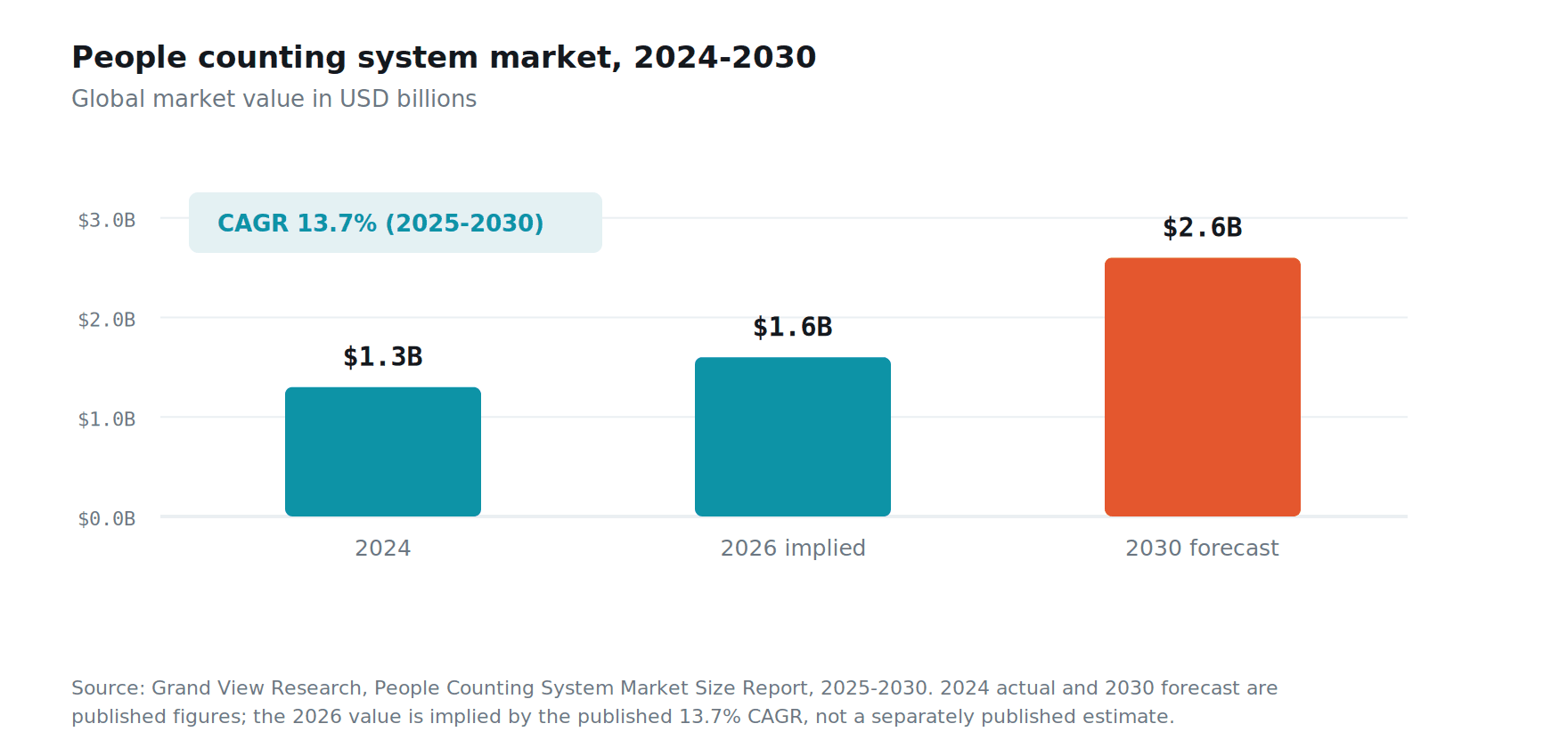
Footfall measurement is now a standard retail tool rather than an enterprise-only system. Grand View Research valued the global people counting system market at USD 1.3 billion in 2024 and forecasts USD 2.6 billion by 2030, a CAGR of 13.7% across 2025-2030. Applying that published growth rate implies roughly USD 1.6 billion by 2026, which is an interpolation rather than a separately published figure.
Retail, supermarkets and shopping malls accounted for more than 20% of that revenue in 2024, and bidirectional counters, which record entries and exits separately, held more than 63% share, on the same Grand View Research segmentation. Falling hardware cost is the reason single-site retailers now appear alongside chains as buyers.
FAQ: Increasing Retail Footfall
What is the fastest way to increase footfall in retail?
Among the ways to answer how to increase footfall in retail, correcting opening hours and local listing data is the fastest fix, because the change costs nothing and takes effect immediately. Stores routinely lose visits to a wrong closing time on a map listing. Check the listing, then compare published hours against the hourly arrival curve from the counter.
How much footfall increase is realistic in one quarter?
A single well-executed tactic typically moves footfall by a low single-digit percentage, not by double digits. Large jumps usually come from an external cause such as a new anchor tenant or a road change. Treat any double-digit claim from a single tactic as a measurement error until the change log confirms otherwise.
Does a people counter pay for itself?
A retail footfall counter usually pays for itself through staff scheduling rather than through marketing. Matching rota hours to the measured traffic curve reduces overstaffing in quiet hours and prevents lost conversion at peaks. A store that cannot see the curve is scheduling on assumption.
Should footfall be counted at the door or across the whole store?
Start with a retail footfall counter at the door, then add zone counting only when the door number is trusted. Entrance counting gives footfall and conversion immediately. Zone counting adds capture rate and dwell time, which are diagnostic rather than headline metrics, and are wasted effort before the baseline is stable.
Do footfall counters comply with privacy law?
A 3D stereo counter that processes depth on the device and transmits counts only does not collect personal data. No image leaves the sensor and no shopper is identified. Confirm with any supplier whether video is streamed off the device, because streaming changes the compliance position entirely.
How does weather affect footfall comparisons?
Weather is the single largest uncontrolled variable in short comparisons of retail footfall data. Comparing a rained-out week against a dry week attributes a weather effect to a tactic. Four-week windows and same-weekday comparison reduce the distortion; logging notable weather days removes the remaining confusion.
Start With the Baseline
None of the 12 tactics can be judged without a count at the door. Retailers deciding how to increase footfall in retail should install measurement first, gather four weeks of baseline, and then change one thing at a time.
Pyroglaux supplies a 3D stereo retail footfall counter range with supplier-stated accuracy in the 95-99% band, PoE power, an open data interface and no mandatory cloud subscription. See the footfall counter range, read the footfall counter buyer's guide, or request a quote.