



Footfall Counter: The Complete Buyer's Guide (2026)
2026-07-24 14:03A footfall counter is a sensor that measures how many people enter and exit a location, and the best option for most retailers is a 3D stereo-vision camera because it counts every visitor bidirectionally with 95 to 99 percent accuracy. The buyer's guide below compares the four main technologies, real accuracy figures, and total cost, so you can pick the right system before you buy.
Choosing a footfall counter is confusing because vendors quote very different accuracy and price numbers. As a manufacturer of people counting devices, our team at PanPanTech installs infrared, camera, and 3D systems every week, and the framework below is the one we give buyers.
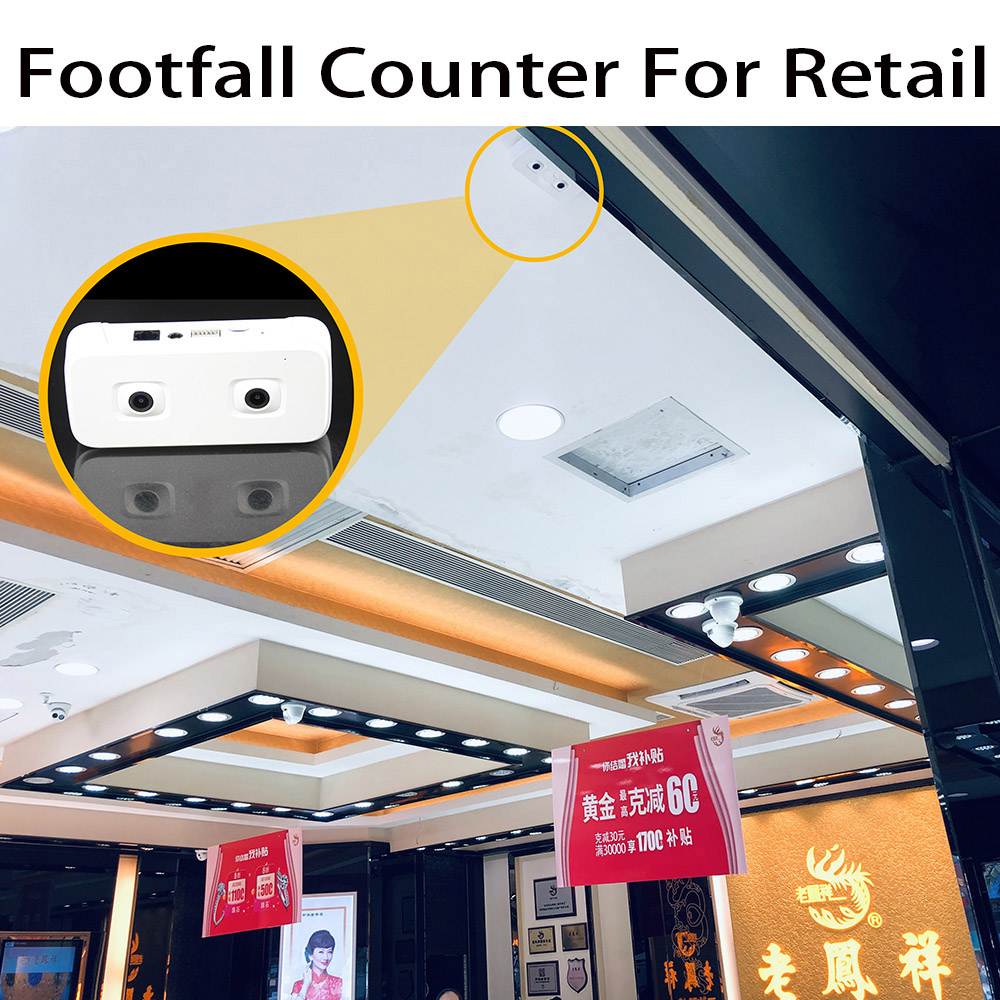
Photo: an overhead 3D footfall counter installed at a retail entrance.
What Is a Footfall Counter?
A footfall counter is a hardware sensor plus software that records visitor entries and exits at a doorway, zone, or whole building, turning raw traffic into data such as peak hours and conversion rate. The same device is also called a people counter, visitor counter, or foot traffic counter, and every version answers one question: how many people came in?
Retailers use the data to calculate conversion rate, which is transactions divided by visitors. Without a visitor counter, a store knows sales but never knows how many shoppers walked past a purchase. Libraries, museums, transit hubs, and offices use the same counting hardware to plan staffing, measure demand, and prove occupancy limits.
What Are the Main Types of Footfall Counter?
There are four footfall counter technologies: infrared beam, thermal, Wi-Fi or Bluetooth, and 3D stereo-vision camera, each with a different accuracy and price point. The table below summarizes how each people counter type performs.
| Counter type | Accuracy | Bidirectional | Relative cost | Best for |
|---|---|---|---|---|
| Infrared beam | 80–90% | Limited | $ | Small single doorways |
| Thermal | 90–95% | Yes | $$ | Low-light, privacy-sensitive |
| Wi-Fi / Bluetooth | 70–85% | N/A (zone) | $$ | Large areas, dwell trends |
| 3D stereo camera | 95–99% | Yes | $$$ | Retail, transit, high traffic |
Source: Milesight People Counting Technology 2026; PanPanTech field data.
How does an infrared beam footfall counter work?
An infrared beam device mounts a transmitter and receiver on each side of a doorway. When a person breaks the beam, the sensor adds one. Beam hardware is the cheapest option, but two people walking side by side register as one, so accuracy drops to 80 to 90 percent and conversion analytics suffer.
How does a 3D stereo footfall counter work?
A 3D stereo device uses two lenses to build a depth map and counts each person as a 3D shape viewed from above. Depth sensing separates people walking together, ignores shopping carts and children by height, and counts in both directions at once. A 3D footfall counter such as the PCBot-R40 AI flow analysis system reaches 95 to 99 percent accuracy in bright or dim light.
How Accurate Does a Footfall Counter Need to Be?
For conversion-rate analytics, a footfall counter should hit at least 95 percent accuracy; below that, the error hides real changes in customer behavior. A store with 1,000 daily visitors and a 90 percent sensor has a 100-person margin of error, which is larger than most week-to-week traffic swings. A 3D device at 98 percent cuts that error to 20 people, making conversion trends trustworthy.
Simple gate counts for a small shop tolerate a cheaper beam sensor. Any business making merchandising, staffing, or marketing decisions from the data needs a high-accuracy 3D people counter.
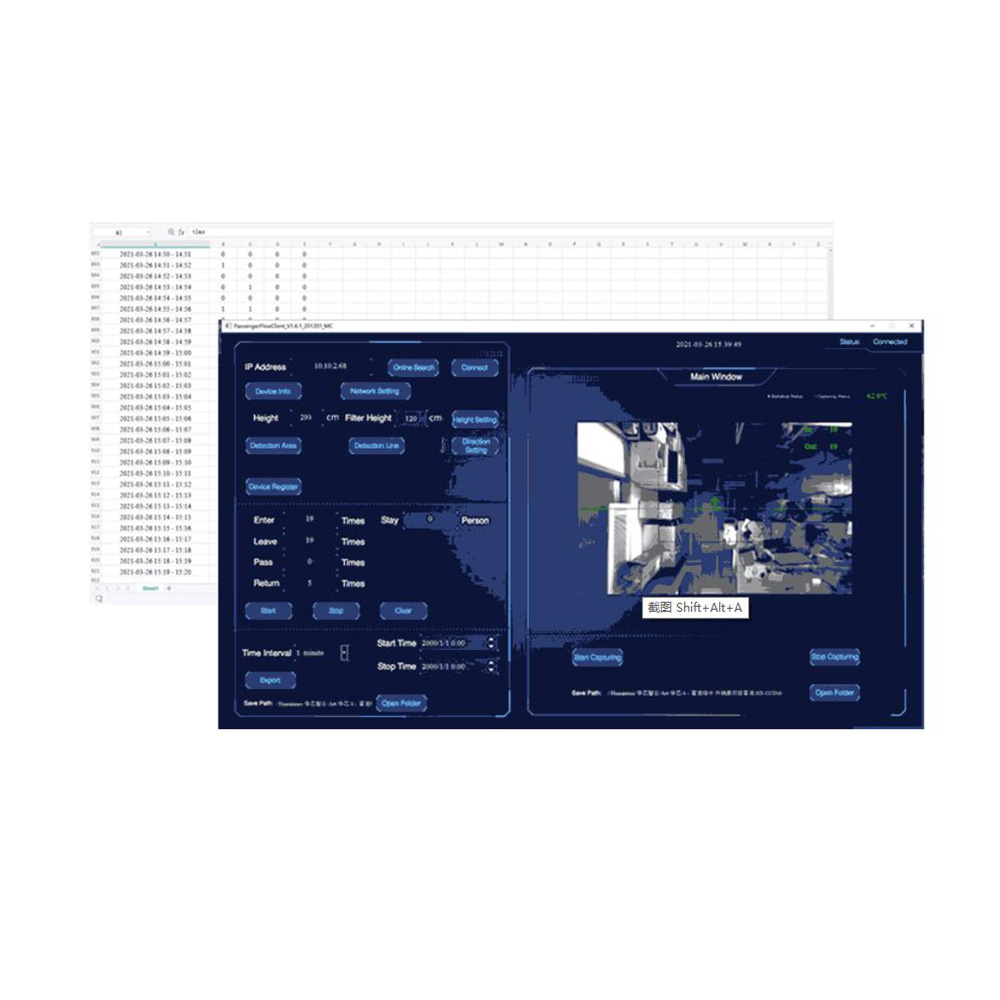
Photo: a footfall counter dashboard showing visitors, conversion rate, and hourly trend.
How Much Does a Footfall Counter Cost?
Footfall counter cost has three parts: hardware per entrance, optional analytics subscription, and installation, so compare total cost of ownership rather than the sticker price of one sensor. Entry-level beam devices start under 100 USD but deliver rough data. A 3D camera costs more per unit yet often needs fewer devices per entrance and rarely requires yearly fees when the vendor offers an open platform.
| Cost component | Beam counter | 3D camera counter |
|---|---|---|
| Hardware per door | Low | Medium–high |
| Analytics subscription | Often none | Varies — ask if optional |
| Installation | DIY possible | PoE, 15-minute mount |
| Data quality | Basic count | Conversion-grade |
Source: PanPanTech quotations, 2024–2026.
Always ask a vendor whether the analytics platform carries a mandatory annual fee. Many premium brands bundle a subscription that doubles the five-year cost. PanPanTech ships a free base dashboard with an open API, so the count data stays yours.
Which Footfall Counter Should You Choose?
Match the footfall counter to the decision it will drive: a beam device for a simple gate tally, a 3D camera for any store that measures conversion. Use this shortlist:
Single small doorway, budget priority: infrared beam counter.
Retail store measuring conversion: 3D stereo people counter with staff exclusion.
Dark or privacy-sensitive site: thermal counter that captures no images.
Mall or large open floor: Wi-Fi zone counter plus 3D cameras at entrances.
Bus or metro: a transit passenger flow counter built for vehicle mounting.
How Big Is the People Counting Market?
The global people counting system market was valued at 1.26 billion USD in 2024 and is forecast to reach 2.65 billion USD by 2030, a 13.7 percent CAGR. Retail analytics and AI sensors drive the growth, and 3D camera adoption is rising fastest.
| Indicator | Value |
|---|---|
| Market size 2024 | USD 1.26 billion |
| Forecast 2030 | USD 2.65 billion |
| CAGR 2025–2030 | 13.7% |
| Largest end use | Retail, supermarkets, malls (20%+) |
Source: Grand View Research, People Counting System Market Report 2025–2030.
FAQ About Footfall Counters
What is the most accurate footfall counter?
A 3D stereo-vision device is the most accurate doorway technology, reaching 95 to 99 percent because depth sensing separates people walking closely together.
Does a footfall counter need Wi-Fi?
Most modern models use PoE Ethernet for power and data. Wi-Fi is optional, though a Wi-Fi counter that estimates devices is a separate zone-level method with lower accuracy.
Can one footfall counter cover a wide entrance?
A single 3D sensor typically covers a doorway up to about 4 meters wide. Wider entrances use two overlapping units that the software stitches into one count.
Is a footfall counter GDPR compliant?
An anonymous footfall counter that stores only a count, not images, avoids personal data and simplifies GDPR compliance for public spaces. Confirm the vendor processes video on the edge and saves no identifiable footage.
How long does installation take?
A PoE 3D people counter mounts above the door and configures through a cloud tool in about 15 minutes per entrance. Request a deployment plan through the PanPanTech contact page.