



Why Privacy-Safe Visitor Counting Matters for Public Venues
2026-06-25 00:00A library people counter records how many visitors enter and leave a building without recording who they are, which is why public venues can measure attendance and still keep the reading room anonymous. A museum people counter answers the same question for a gallery. Libraries, museums, galleries, scenic areas and civic buildings need attendance evidence for funding and staffing, and they need it without turning a public space into a surveilled one.
The tension around visitor counting is real but narrower than it first appears. Attendance planning needs totals, patterns and peaks. Almost none of those questions require knowing anything about an individual visitor, so a counting system designed around totals answers the operational need and sidesteps the privacy problem entirely.
What Does a Venue Actually Need to Measure?
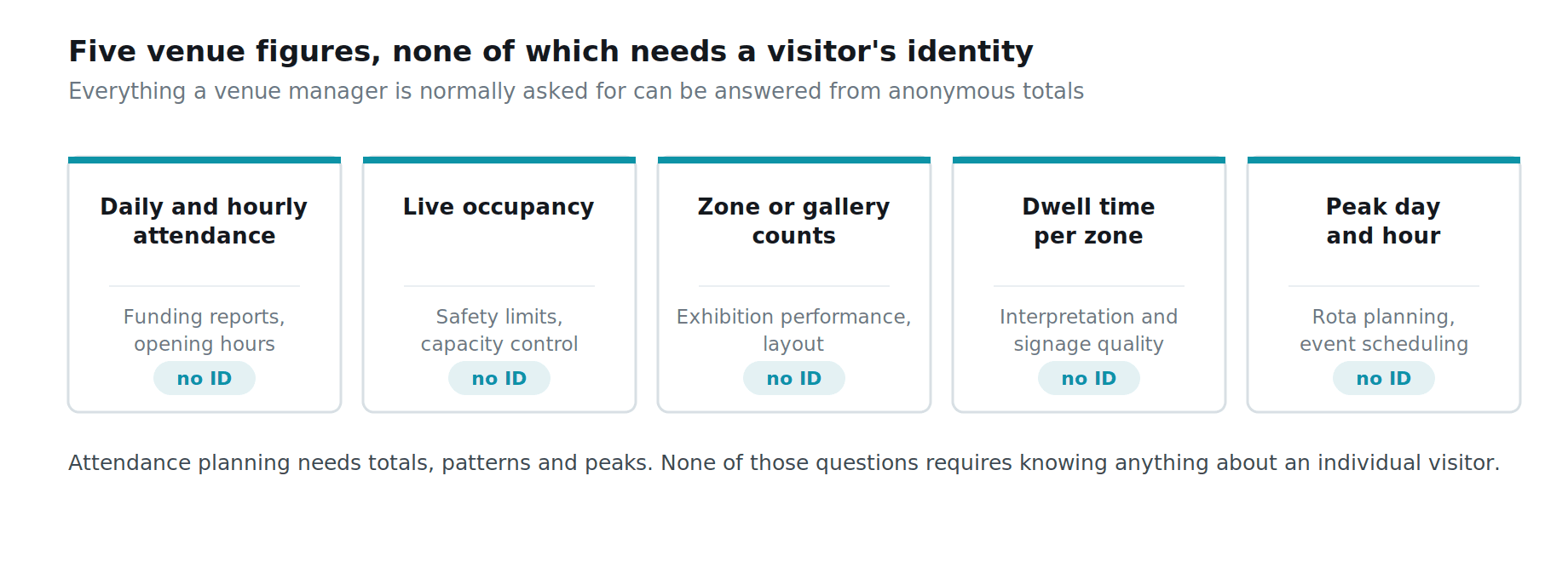
Five figures from visitor counting cover nearly every question a venue manager is asked. None of the five requires identifying a person.
| Figure | Used for | Needs identity? |
|---|---|---|
| Daily and hourly attendance | Funding reports for a library people counter deployment | No |
| Live occupancy | Safety limits, capacity control | No |
| Zone or gallery counts | Exhibition performance, layout | No |
| Dwell time per zone | Interpretation and signage quality | No |
| Peak day and hour | Rota planning, event scheduling | No |
What Makes a Counting System Privacy-Safe?
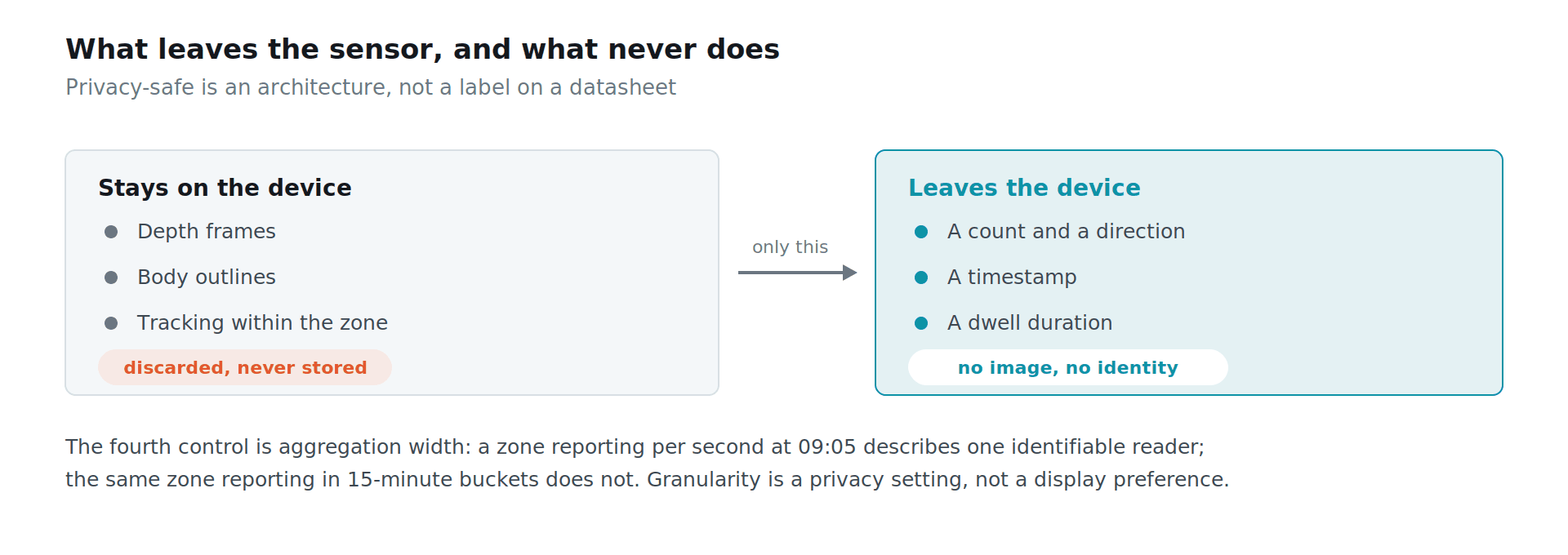
Privacy-safe visitor counting is an architecture, not a label a supplier applies to a product. Four design decisions decide whether a museum people counter processes personal data or not.
Privacy-safe visitor counting rests on four points. Depth frames are analysed on the device and discarded, so no image is stored or transmitted. The payload leaving the sensor carries counts, timestamps and durations only. No identifier links a crossing to a named person or a membership record. Aggregation windows are wide enough that a single visitor cannot be isolated in a quiet gallery.
The fourth point is the one visitor counting projects most often miss. A zone reporting every 15 minutes is anonymous when twenty people pass through; the same zone reporting per second at 09:05 on a Tuesday morning describes one identifiable reader. Aggregation granularity is a privacy control, not a display preference.
Which Counting Technology Suits a Public Venue?
Three visitor counting technologies appear in venue tenders, and only one of them counts reliably without capturing recognisable images.
| Technology | Accuracy at a busy door | Privacy position |
|---|---|---|
| Infrared beam | Low, merges people crossing together | No image at all |
| Single-lens video analytics | Medium, depends on lighting | Captures recognisable video |
| 3D stereo depth | High, separates by height | Depth processed and discarded on device |
Beam-based visitor counting is genuinely private and genuinely inaccurate; a busy library entrance will undercount whenever two readers walk in side by side. Single-lens analytics counts better but works on recognisable video, which changes the compliance conversation. Depth sensing gives the accuracy without the imagery, which is why most venue installations end up there.
Pyroglaux 3D units are specified in the 95-99% accuracy band depending on model and mounting, mounted between 2.2 m and 6.0 m with a covered span of 1.2-5.5 m. Confirm the figure for a specific model against the datasheet before writing it into a tender.
How Should a Venue Explain the System to Visitors?
Publish what the visitor counting system collects before anyone asks. A short notice at the entrance prevents most of the concern that an unexplained sensor above a door creates.
Four sentences usually suffice: the venue counts how many people are inside, the sensors do not record images, no visitor is identified, and the figures are used for safety and planning. Adding the retention period and naming the department responsible turns a defensive notice into a credible one.
Venues bound by public-sector transparency obligations should also publish a data protection assessment covering the visitor counting system. The exercise is short when the answer to "what personal data is processed" is "none", and having it on file removes the question from every future committee meeting.
Where Do Zone Counts Add More Than Door Counts?
Door-line visitor counting tells a venue how busy the building is; zone counting tells a venue whether the building works. The second question is the one that changes exhibitions and layouts.
People counting in museums is where zone data pays off fastest. A gallery that receives 8% of building traffic when it holds 20% of the floor area has a wayfinding problem, not a content problem. Zone-level visitor counting is what makes the distinction visible. Dwell time separates the two: short dwell with high entry means visitors arrive and leave quickly, while low entry with long dwell means the people who find the gallery stay, and the route is failing.
People counting in museums at zone level is worth adding only once the entrance number is trusted. A venue that has not yet established a stable door baseline gains nothing from splitting an unreliable total into unreliable parts.
What About Occupancy Limits?
Live occupancy is the one visitor counting metric that needs near real-time data rather than a daily report. Entry minus exit, updated continuously, drives a capacity display or an alert to a duty manager.
Two visitor counting configuration points decide whether the occupancy figure stays trustworthy through a long day. Every entrance and exit needs a sensor, because one uncounted fire-exit route makes the running total drift upward until closing. A scheduled reset at opening time clears accumulated drift, so each day starts from a known zero rather than from yesterday's residue.
FAQ About Visitor Counting in Public Venues
Does a library people counter identify individual visitors?
No, when the system is depth-based and processes frames on the device. The sensor outputs a crossing event with a direction, a timestamp and a duration. No image is stored, no face is matched, and nothing connects a crossing to a library card or a membership record.
Is a museum people counter compliant with GDPR?
A counter that processes no personal data falls outside the regulation's scope for that processing. Compliance turns on the architecture rather than the product name, so confirm with the supplier that video is not streamed off the device for analysis elsewhere. Streaming recognisable video changes the position entirely, wherever the analysis happens.
How accurate does visitor counting need to be?
Attendance reporting tolerates a few percent; occupancy limits do not. A venue people counter used only for annual figures is held to a looser standard than one enforcing a capacity cap. A funding report built on a 96% accurate count is sound. A capacity control that must not exceed a legal limit needs the higher end of the accuracy band plus every door instrumented, because an uncounted exit biases the running total in the dangerous direction.
Can one sensor cover a wide entrance hall?
Coverage scales with mounting height rather than requiring more devices at every width. A unit at 5 m covers a wider span than the same unit at 3 m. Entrances beyond a single device span use two units with a configured overlap so the shared area is not counted twice.
Does outdoor visitor counting need different equipment?
Outdoor installations need weather rating and a plan for direct sunlight. Depth sensing handles changing light better than single-lens analytics, but a sensor pointed into a low winter sun still needs a mounting angle that avoids it. Gate structures and ticket lines usually give a suitable overhead position.
How does visitor counting data reach a venue reporting system?
Through an HTTP JSON interface returning counts as structured events. A small venue can export a daily total; a multi-site organisation pulls events into a warehouse and reports across buildings. The people counting software and API integration guide covers the data model and a first request.
Getting Started
Start visitor counting at the main entrance, publish the visitor notice at the same time, and gather four weeks of baseline before drawing conclusions. Venues that add zone counting later, on top of a trusted door figure, get more from the second phase than venues that install everything at once.
Pyroglaux supplies a 3D stereo venue people counter range for libraries, museums, galleries and scenic areas, with PoE power, on-device processing and no mandatory cloud subscription. See the venue counting range, read the workplace and venue occupancy guide, or request a site plan review.