



Passenger Counting System Supports Smarter Bus and Metro Operation
2026-06-25 00:00Automatic passenger counting is the measurement of boardings and alightings at vehicle doors without a person doing the counting, and the data is what turns a timetable from an assumption into a decision. Bus and metro operators use automatic passenger counting to size vehicles to demand, reallocate service between routes, and evidence ridership in funding submissions.
Manual surveys still exist, and the limitation is sampling rather than effort. A surveyor covers a handful of runs on a handful of days, then the result is scaled to a full timetable. An automatic passenger counting system records every door event on every run, which removes the extrapolation step entirely.
How Does an Automatic Passenger Counting System Work?
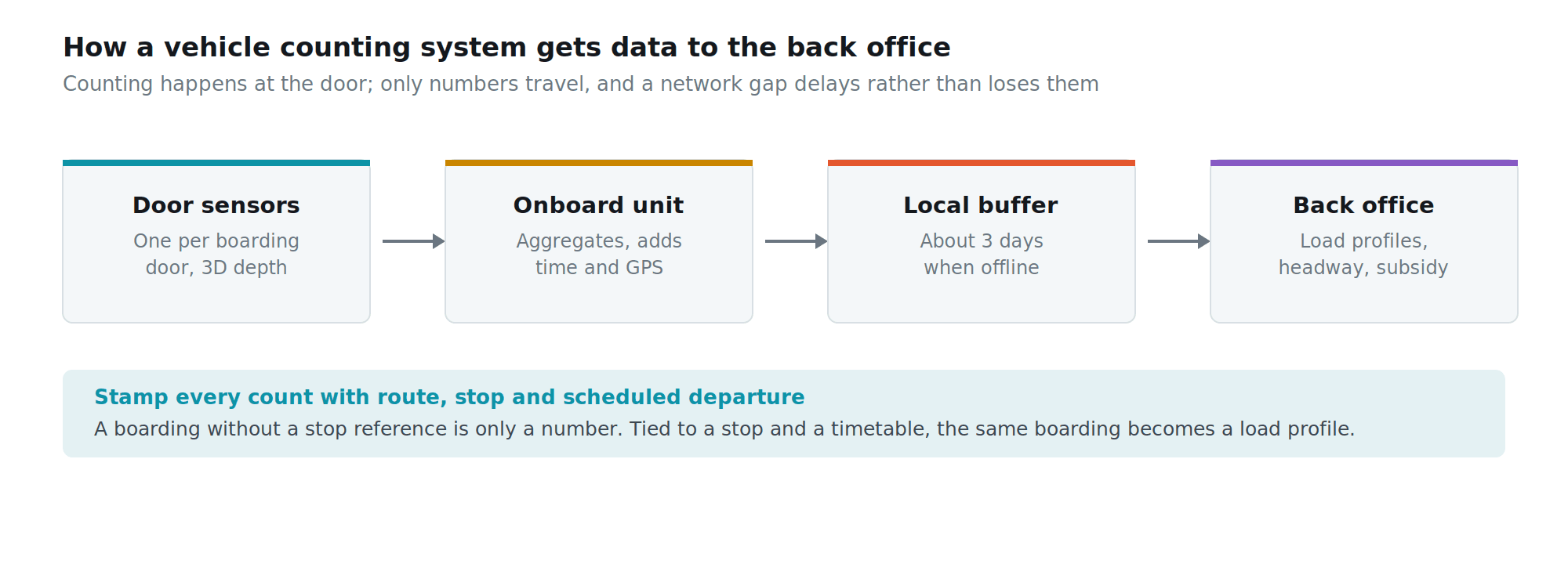
A sensor above each door watches the boarding zone in three dimensions and classifies every crossing as a boarding or an alighting. Counting happens on the device; only the resulting numbers travel.
Three components make up an automatic passenger counting installation on a vehicle. Door sensors detect and classify crossings. An onboard unit aggregates the counts, stamps them with time and position, and buffers the record when the network drops. A back-office link forwards the buffered data once the vehicle reaches coverage or a depot.
Position stamping is what turns a bus passenger counting system output into an operational fact. A boarding without a stop reference is only a number; the same boarding tied to a route, a stop and a scheduled departure becomes a load profile that planners can act on.
What Makes a Vehicle Harder Than a Shop Doorway?
Every condition that degrades automatic passenger counting accuracy is worse on a moving vehicle. An automatic passenger counting system has to hold accuracy where a retail counter would not be asked to work at all.
| Vehicle condition | Effect on counting | What the design has to do |
|---|---|---|
| Low door height | Sensor sits close to heads | Wide field of view at short range |
| Crowded boarding | Bodies overlap in the door | Separate people by depth, not outline |
| Sun, tunnels, night | Lighting swings within seconds | Infrared illumination, automatic switching |
| Vibration and shock | Mounting drifts over months | Rigid mount, vibration-rated housing |
| Standing passengers | People linger in the door zone | Track crossings, not presence |
Accuracy specifications reflect the difficulty. Retail-grade devices are quoted at 98% or better; vehicle-grade passenger counters in the Pyroglaux range are specified at 95-96% depending on model, with the bus version covering a 1.9-3.5 m mounting height and the small-bus version working as low as 1.5 m. Ask any supplier for results measured on a moving vehicle rather than on a static doorway.
Which Vehicles Suit Which Sensor?
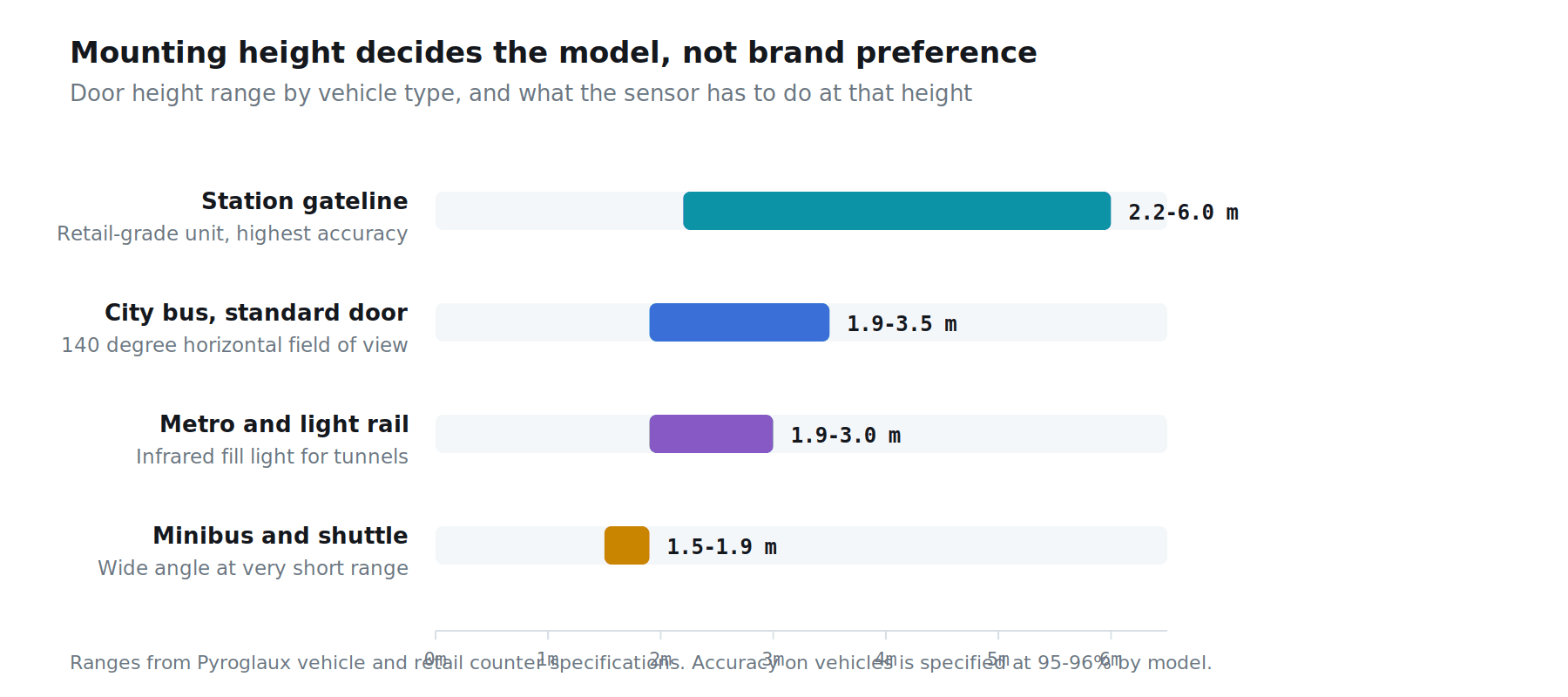
Door height and doorway width decide the automatic passenger counting model long before brand preference does. A single specification rarely covers a full mixed fleet.
| Vehicle type | Typical mounting height | Sensor characteristic needed |
|---|---|---|
| City bus, standard door (bus passenger counter) | 1.9-3.5 m | 140 degree horizontal field of view |
| Minibus and shuttle | 1.5-1.9 m | Wide angle at very short range |
| Metro and light rail | 1.9-3.0 m | Infrared fill light for tunnel running |
| Station gateline | 2.2-6.0 m | Retail-grade unit, higher accuracy |
What Do Operators Actually Do With the Data?
Automatic passenger counting answers four planning questions that a ticketing system cannot. Ticket data records who paid; an automated passenger counter records who travelled, including concessionary, transfer and unticketed journeys.
A bus passenger counter on every door makes load profiling possible: the data shows where on a route the vehicle fills and empties, which drives vehicle size and short-working decisions. Headway adjustment uses boarding peaks per stop rather than a uniform frequency across the day. Stop rationalisation identifies stops with negligible activity. Subsidy reporting uses continuous counts rather than a survey sample, which usually survives audit better.
Dwell time per door is the quieter benefit. Long dwell at one door on a repeated run points to a boarding bottleneck that a timetable change alone will not fix.
How Does a Passenger Counter Connect to the Back Office?
An automatic passenger counting unit buffers locally and forwards structured records, so a network gap delays data rather than losing it. Devices typically retain around three days of history, which covers a weekend outage comfortably.
A bus passenger counting system integrates the same way as any counting deployment: an HTTP JSON interface returning events with a timestamp, a direction and a duration, either pulled on a schedule or pushed to an endpoint. Fleet deployments favour push, because the vehicle then needs only outbound access and no inbound firewall rule per bus.
Two details deserve attention at commissioning. Configure a time server so device clocks stay aligned with the scheduling system, since drift makes boardings sort incorrectly against the timetable. Track the last ingested record per vehicle so a reconnection resumes rather than restarts.
Does Passenger Counting Collect Personal Data?
Depth-based automatic passenger counting that processes frames on the device and transmits counts only does not identify passengers. No image leaves the sensor and no travel history attaches to a person.
Public transport authorities usually ask a narrower question than regulators do: can this system tell anyone who was on the 07:40 service? A system reporting boardings and alightings per door per stop cannot answer that, and stating so plainly shortens the approval conversation.
What Should a Tender Specify?
Six clauses separate an automatic passenger counting specification that can be evaluated from one that cannot. Vague accuracy language is where most disputes begin.
| Clause | What to write |
|---|---|
| Accuracy | State the percentage and the test method, on a moving vehicle |
| Acceptance test | Controlled boardings per door, agreed count, agreed tolerance |
| Mounting | Height range per vehicle type in the fleet |
| Environment | Operating temperature, vibration, ingress protection |
| Data interface | Open documented API, no subscription gate on raw data |
| Buffering | Minimum retention when the vehicle is out of coverage |
FAQ About Automatic Passenger Counting
How accurate is a bus passenger counter in service?
Vehicle-grade systems are typically specified at 95% or better under real boarding conditions. Accuracy falls when passengers crowd the doorway or linger on the step, which is why depth-based sensing outperforms beam and single-lens counting on vehicles. Always compare figures measured on a moving vehicle, not on a static test doorway.
Does an automatic passenger counter replace ticketing data?
No, the two measure different things and are strongest together. Ticketing records paid journeys; an automated passenger counter records everyone who boarded, including concessionary travel, transfers and fare evasion. The gap between the two series is itself a useful operational figure.
How many sensors does a vehicle need?
One per door used for boarding or alighting. A two-door city bus needs two units. Covering only the front door produces a boarding count with no matching alighting count, which makes load profiling impossible.
What happens when the vehicle loses network coverage?
Counts buffer on the vehicle and upload when coverage returns. Around three days of retention is typical, which covers depot layovers and tunnel running. The back-office ingester should track the last record received per vehicle so the backlog is recovered rather than skipped.
Can passenger counting work on metro trains as well as buses?
Yes, with a model specified for tunnel lighting. Metro doors swing between daylight at surface stations and darkness in tunnels within seconds, so the sensor needs infrared illumination that switches automatically. Mounting height on metro stock generally sits between 1.9 m and 3.0 m.
How is the system accepted at handover?
Controlled boardings, counted by hand, compared against the device. Ten to twenty passes per door in each direction, run at a normal boarding pace, is enough to expose direction errors and configuration mistakes. A mismatch at acceptance is nearly always a configuration problem rather than a hardware fault.
Next Steps
Roll out automatic passenger counting on one vehicle type and one route first. Confirm accuracy with a controlled acceptance test, run four weeks against the existing timetable, and only then extend the specification to the rest of the fleet.
Pyroglaux supplies a vehicle-grade 3D bus passenger counter range covering buses, minibuses and metro stock, with 4G and GPS options, an open data interface and full documentation. See the passenger counting range, review the data integration guide, or request tender support documents.