



Metro Passenger Counting: Gatelines, Concourses and Platforms
2026-08-29 19:50Metro passenger counting at stations answers a different question from counting on the train: not how many people rode, but how many are standing on the platform right now and whether the concourse can absorb the next arrival. Station counting drives crowd control, gateline staffing and interchange planning, none of which onboard data can inform in time to matter.
Ticketing data will not substitute for metro passenger counting. A gate validation records a paid entry at a point in time, while metro passenger counting records where people actually accumulate: the platform end that fills first, the interchange corridor that backs up, the exit nobody uses.
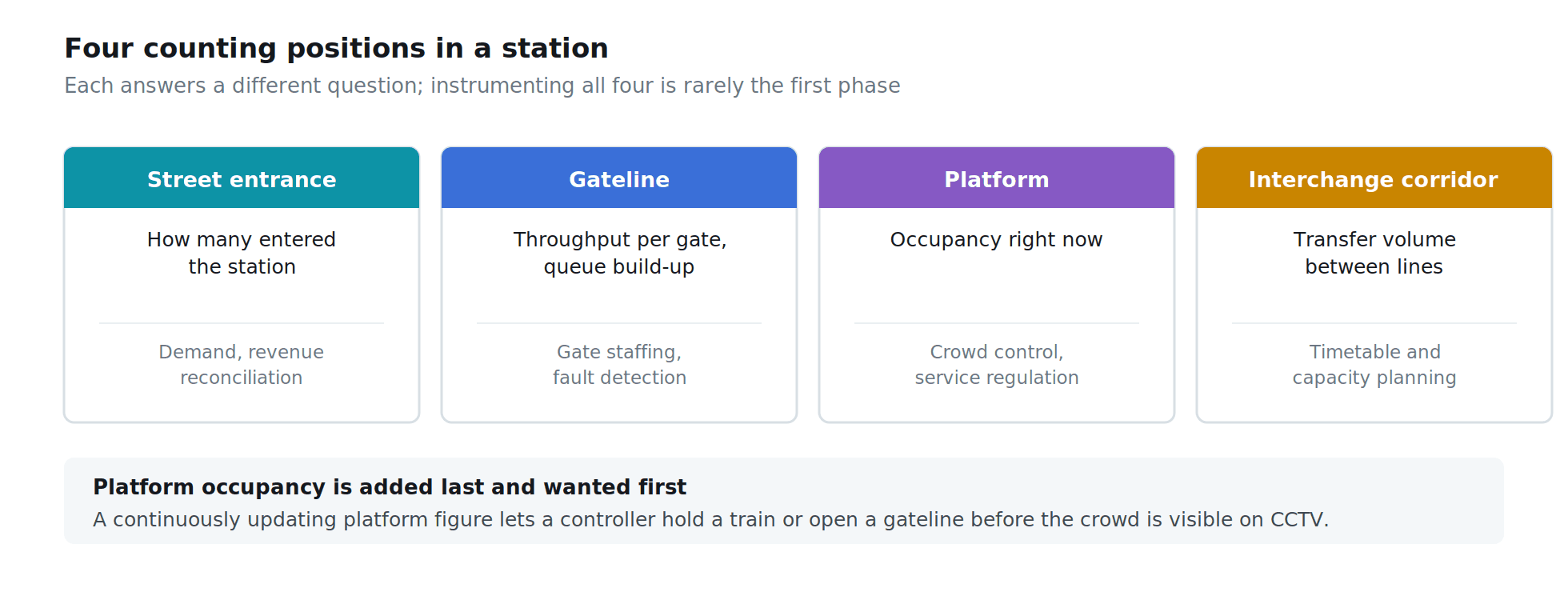
Where Does a Station Need Counters?
Metro passenger counting uses four position types, and each answers a distinct operational question. Instrumenting all four is rarely the first phase; knowing which one the station most needs is the useful step.
| Position | Question answered | Used by |
|---|---|---|
| Street entrance | How many people entered the station | Demand and revenue reconciliation |
| Gateline | Throughput per gate, queue build-up | Gate staffing, fault detection |
| Platform | Platform occupancy right now | Crowd control, service regulation |
| Interchange corridor | Transfer volume between lines | Timetable and capacity planning |
Platform occupancy is the figure most often added last and wanted first. A platform figure updating continuously is what lets a controller hold a train, open a gate line or trigger a crowd announcement before the situation becomes visible on CCTV.
Why Are Stations Harder Than Shop Doorways?
Every condition that degrades metro passenger counting accuracy appears in a station at once. A sensor specified for a retail entrance will underperform on a gateline.
Density is the first difference for metro passenger counting. Passengers move in surges timed to train arrivals rather than at a steady rate, so a sensor has to separate people who are genuinely touching rather than merely near each other. Depth sensing separates by height, which is why 3D stereo outperforms beam and single-lens counting where crowds are dense.
Lighting is the second. A surface station swings between direct sunlight and deep shadow within one train length, and an underground platform runs at low light permanently. Metro passenger counting equipment therefore needs infrared illumination that switches automatically rather than a fixed exposure.
Luggage, prams and bicycles are the third. Height filtering excludes objects below a threshold, but a passenger wheeling a large case reads differently from a passenger walking, and the filter has to be set against the station's real traffic rather than a default.
What Specification Suits Station Positions?
Station passenger counting splits by position: gatelines and concourses take retail-grade devices, platform edges and door zones take vehicle-grade ones. Mounting height decides which.
| Position | Mounting height | Field of view | Accuracy class |
|---|---|---|---|
| Gateline, concourse | 2.2-6.0 m | 100 x 70 degrees | 98% or better |
| Wide corridor, zone | 1.9-3.2 m | 140 x 115 degrees | 98% or better |
| Platform, train door | 1.9-3.0 m | 140 x 120 degrees | 95% or better, infrared fill |
Source: Pyroglaux counting sensor specifications. Rail-position devices draw under 5 W, rising to under 10 W with infrared illumination active.
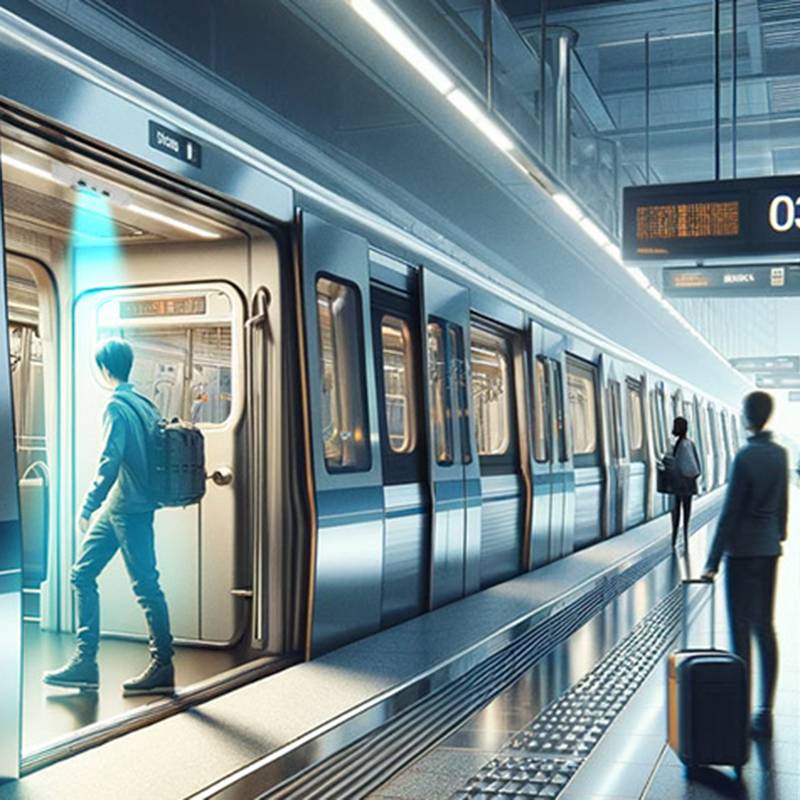
Ceiling height in older stations is the constraint that most often forces a redesign. A vaulted Victorian concourse and a modern box station need different mounting plans for the same throughput, and a survey before specification saves a return visit.
How Does Station Data Reach the Control Room?
Counting happens on the device and only numbers travel, which is what makes near real-time platform occupancy practical. Video would need bandwidth that station networks rarely have spare.
Two station passenger counting patterns apply. Polling suits reporting and planning, where a five-minute interval is ample. Push to a webhook suits crowd control, where the delay between a platform filling and a controller seeing the number is the whole point of the system.
Devices buffer roughly three days locally, so a network interruption in a tunnel segment delays the record rather than losing it. An ingester that tracks the last processed index per device recovers the gap automatically on reconnection.
Clock synchronisation deserves attention at commissioning. Platform counts that sort incorrectly against the timetable cannot be tied to a specific service, and the whole analysis depends on that join. Configure a time server before handover rather than after the first mismatched report.
Does Station Counting Identify Passengers?
Depth-based metro passenger counting that processes frames on the device and transmits counts only does not identify anyone. No image leaves the sensor, no face is matched, and no count attaches to a travel record.
Transport authorities usually ask a narrower question than regulators do: can this tell anyone who was on the 07:40? A system reporting entries, exits and occupancy per zone per interval cannot answer that, and saying so plainly shortens the approval process.
Publishing the retention period, the aggregation interval and the field list before installation removes most of the remaining objections. Counting programmes that skip the disclosure step tend to stall at consultation rather than at commissioning.
What Belongs in a Station Counting Tender?
Six clauses make a station passenger counting specification that can be evaluated rather than argued about.
| Clause | What to write |
|---|---|
| Accuracy | Percentage plus test method, measured under surge conditions |
| Acceptance | Controlled passes per position, agreed count and tolerance |
| Lighting | Performance stated for both daylight and unlit running |
| Mounting | Height range per position type in the station |
| Latency | Maximum delay for live platform occupancy, if used for crowd control |
| Data interface | Open documented API, no subscription gate on raw counts |
The latency clause is the one most often omitted and most often needed. A system adequate for monthly reporting can be useless for crowd control if the platform figure arrives two minutes late.
How Does Station Counting Relate to Onboard Counting?
Metro passenger counting at stations measures the platform; onboard counting measures the vehicle, and the two together close the loop. Neither replaces the other.
Platform data shows demand waiting; onboard data shows whether the arriving service could absorb it. The difference between the two is left-behind demand, which is the number that justifies extra services far better than either figure alone.
Operators adding metro passenger counting to an existing fleet system usually start with whichever is causing complaints. Crowding complaints point to platforms; capacity disputes point to vehicles. The automatic passenger counting guide for vehicles covers the onboard side.
FAQ About Metro and Station Passenger Counting
How accurate is metro passenger counting on a crowded platform?
Depth-based systems are specified at 95% or better under surge conditions, and accuracy falls as density rises on every technology. Compare figures measured during train arrival surges rather than on an empty concourse, because the empty-concourse number tells a buyer nothing about the condition that matters.
Can gateline counters replace ticket gate data?
No, and the gap between the two is itself useful. Gates record validations; counters record people, including staff, children travelling free and anyone passing through an open gate. The difference is a fare-evasion and gate-fault indicator that neither source produces alone.
Does infrared illumination disturb passengers?
No, infrared fill light sits outside the visible spectrum. Passengers see nothing; the sensor gets a usable image in an unlit tunnel station. Power draw rises when illumination is active, which is why the specification quotes both figures.
How many sensors does one platform need?
Platform occupancy coverage depends on mounting height and platform width, so a survey decides rather than a formula. Long platforms usually need several units with configured overlaps so the shared area is not double counted. Under-instrumenting a platform produces a partial figure that reads as a low crowd.
Can the same devices serve a bus fleet and a station?
The technology is shared but the models differ by mounting height and environmental rating. A vehicle unit is built for vibration and a low door; a concourse unit is built for a high ceiling and a wide span. Operators running both use the appropriate device for each rather than one compromise unit.
What is the first thing to measure in a new deployment?
Entrance totals, before anything zone-level. A trusted station-entry figure is what every later number is checked against. Zone and platform counts added on top of an unverified entrance total inherit its errors without anyone noticing.
Next Steps
Start metro passenger counting at one station and one position type. Confirm accuracy with controlled passes during a real arrival surge, run four weeks against the timetable, and only then write the specification for the rest of the network.
Pyroglaux supplies station passenger counting sensors for gatelines, concourses and platforms, with infrared fill light, PoE power and an open documented interface. See the counting sensor range, review the data integration guide, or request tender support documents.