
Table of Contents
- Why parcel dimensions matter
- How static volume measurement works
- How dynamic volume measurement works
- Static vs dynamic: side-by-side comparison
- 3D sensing technologies used in dimensioners
- Legal for trade: when certification is needed
- How to choose a dimensioning system
- Where Pyroglaux fits
- Frequently Asked Questions
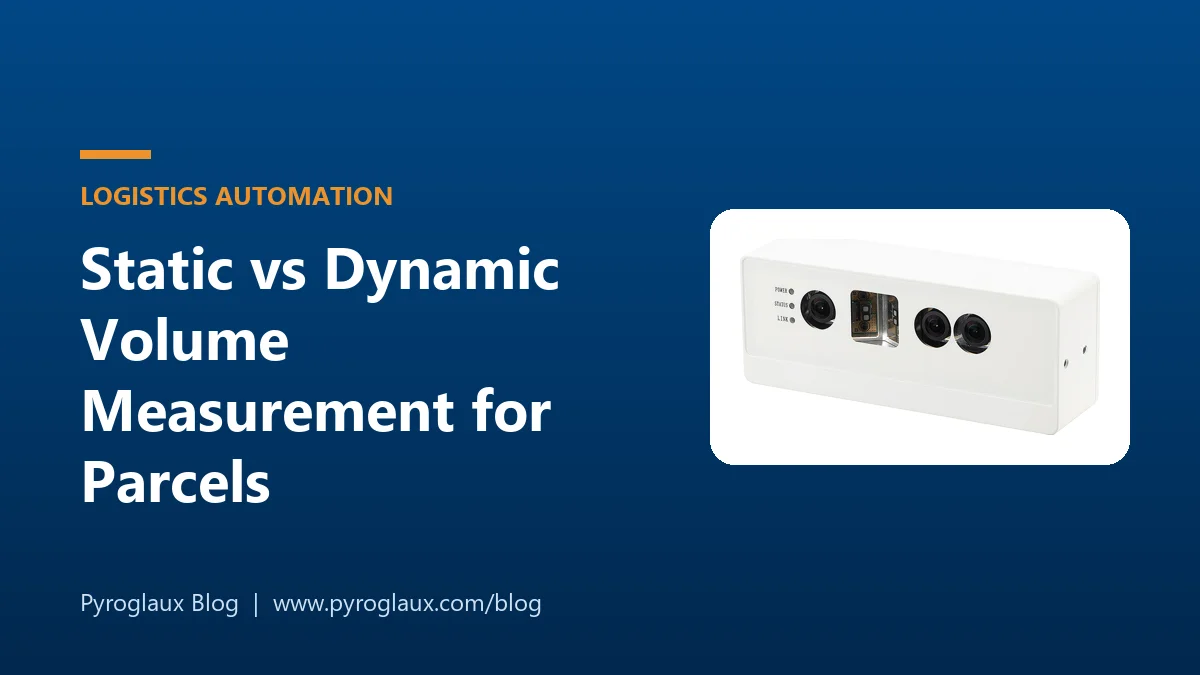
Static volume measurement dimensions an item while it stands still under a 3D camera, which suits receiving desks, shipping counters and low volumes; dynamic volume measurement dimensions items while they move on a conveyor or forklift, which suits sortation hubs and high-volume warehouses. Both turn length, width and height into data for dimensional weight billing, storage planning and automation, but they differ in throughput, cost and installation.
This guide explains how each setup works, compares accuracy and throughput, covers legal-for-trade rules, and gives a checklist for choosing a parcel dimensioning system.
Why parcel dimensions matter
- Dimensional weight. Carriers charge by the greater of actual weight and dimensional weight, which is length × width × height divided by a carrier-specific divisor. Wrong dimensions mean lost revenue or carrier surcharges.
- Warehouse slotting and storage. Accurate item dimensions decide which location and which bin an item fits.
- Cartonization and packing. Packing software needs dimensions to choose the right box and reduce void fill.
- Load planning. Trucks, containers and air cargo are planned on volume as well as weight.
- Automation safety. Sorters, robots and conveyors need to reject oversize items and detect two parcels stuck together.
How static volume measurement works
A 3D camera is mounted above a measuring area, often a table or a platform scale. An operator places the item, the camera captures a depth image, and software calculates the smallest enclosing box: length, width and height. With a scale and barcode reader, one station records dimensions, weight and identity in a few seconds.
Static systems handle almost anything that fits under the camera: boxes, bags, irregular items, tires and small furniture. Larger versions measure pallets and bulky freight from above. They are the simplest and cheapest way to start, and they work well at receiving, returns, retail shipping counters and in master-data teams that measure new SKUs.
Limits of static measurement
Throughput depends on people. Each item has to be placed, measured and removed, so static stations become a bottleneck when volumes rise, and results depend on operators placing items correctly.
How dynamic volume measurement works
In a dynamic system, one or more 3D cameras are mounted over a conveyor. A photoelectric sensor triggers the measurement as each parcel enters the field of view, and a belt encoder tells the system how fast the parcel is moving, so the software can assemble the 3D shape while the parcel passes. Dimensions are sent to the warehouse or sorting software together with the barcode and weight, usually within the time the parcel takes to travel to the next decision point.
Dynamic dimensioning is the standard in parcel hubs, e-commerce fulfillment centers and cross-docks, where thousands of parcels per hour pass a single point. The same 3D data supports extra checks that matter for automation:
- Double-item detection. Two parcels touching or stacked are flagged before they cause a missort.
- Oversize detection. Items that exceed the sorter limits are diverted.
- Position correction. The parcel's position and angle on the belt help downstream equipment center and orient it.
- Empty tray detection. On tilt-tray and cross-belt sorters, the camera confirms whether a tray is empty.
Drive-through measurement for pallets and freight
A related dynamic setup measures palletized freight while a forklift drives through a gate under the cameras. It removes the need to set the pallet down at a measuring station, which saves time at busy docks.
Static vs dynamic: side-by-side comparison
| Factor | Static measurement | Dynamic measurement |
|---|---|---|
| How items are measured | Placed and measured standing still | Measured while moving on a conveyor or forklift |
| Throughput | Limited by operators, a few seconds per item | Matches conveyor speed, thousands of items per hour |
| Item range | Very wide, including irregular and bulky items | Items that the conveyor can carry; separate setups for pallets |
| Installation | Simple: camera stand, table or scale | Integrated into the conveyor with triggers, encoder and WMS or sorter software |
| Typical sites | Receiving, returns, shipping counters, SKU master data | Parcel hubs, sortation, e-commerce fulfillment, cross-docks |
| Extra automation checks | Limited | Double items, oversize, position, empty trays |
| Cost | Lower per station | Higher, but lower cost per measured item at volume |
3D sensing technologies used in dimensioners
- Active stereo vision. Two cameras plus a projected pattern calculate depth, with color data alongside. Robust under varied warehouse lighting and good with irregular shapes.
- Time-of-flight (ToF) cameras. Measure the travel time of light to calculate depth for every pixel; compact and fast, with some sensitivity to very dark or shiny surfaces.
- Laser line and light curtain scanners. Classic dynamic dimensioners scan a laser line or light curtain across the belt; accurate on boxes, but often more expensive and less flexible with irregular items.
Whatever the technology, ask how the system handles difficult items: thin envelopes and polybags, black or glossy packaging, transparent film, bulging boxes and items that overhang the belt. Our article on RGBD volume measurement cameras in logistics covers accuracy factors in more detail.
Legal for trade: when certification is needed
If the dimensions are used to calculate charges, for example to bill shippers by dimensional weight, many countries require a legal-for-trade approved dimensioner. In the United States this is typically handled through the National Type Evaluation Program (NTEP); many other countries base their approvals on the international recommendation OIML R 129 for multi-dimensional measuring instruments. Approval covers specific models, measuring ranges and resolutions. If you use dimensions only internally, for slotting, packing, load planning or auditing carrier invoices, certification is usually not required. Confirm the rules in your market before buying.
How to choose a dimensioning system
- Volume and flow. Fewer than a few hundred items a day at one point usually points to static stations; continuous conveyor flow points to dynamic measurement.
- Item profile. List the smallest, largest, thinnest and most irregular items. Check that one system covers the range, or plan separate parcel and pallet setups.
- Accuracy and resolution. Define the accuracy you need per size class, and whether legal-for-trade approval is required.
- Conveyor speed and gaps. For dynamic systems, give the belt speed, parcel spacing and conveyor width.
- Integration. Agree how dimensions, weight, barcode and images reach your WMS or sorter controller, and the response time required.
- Testing. Run a test with a few hundred of your real parcels and compare against manual measurement.
- Support. Check calibration procedures, spare parts and remote support, because a stopped dimensioner can stop a sorting line.
Where Pyroglaux fits
Pyroglaux supplies active-stereo RGBD volume measurement cameras for both static and dynamic dimensioning. According to the manufacturer's specifications, the range covers dynamic measurement on conveyors of parcels up to 1600 × 1100 × 800 mm, including thin items down to about 5 mm such as envelopes; large-cargo and pallet measurement up to about 1500 × 1500 × 1800 mm, including drive-through measurement on forklifts; and heavy-duty models with average accuracy of about ±10 mm for large items. The same cameras support double-item detection, oversize detection, position correction and empty tray detection. See our depth cameras and industrial 3D cameras, and the warehouse package volume measurement project. Send us your item range, flow rate and conveyor details, and we will recommend a setup and arrange a test with your parcels.
Frequently Asked Questions
What is the difference between static and dynamic volume measurement?
Static volume measurement measures an item that stands still, for example on a table or scale under a 3D camera. Dynamic volume measurement measures items while they move on a conveyor or on a forklift, without stopping the flow.
How accurate are 3D camera dimensioners?
Accuracy depends on the item size, mounting height, conveyor speed and the camera. Industrial 3D cameras for large cargo typically state accuracy of around ±10 mm, and smaller parcel systems are often tighter. Always test with your own parcels, including thin, dark and irregular items.
Can a dimensioner measure irregular or soft parcels?
Yes. 3D cameras measure the real shape, so bulging boxes, bags and irregular items can be measured. The system reports the smallest box that encloses the item, which is what carriers use for dimensional weight.
Do I need a certified dimensioner?
If the measurements are used to bill customers or carriers, many countries require a legal-for-trade approved device, for example under NTEP in the United States or approvals based on OIML R 129 elsewhere. For internal use such as slotting, cartonization or carrier audits, certification is usually not required.
What is a DWS system?
DWS stands for dimensioning, weighing and scanning. A DWS system combines a dimensioner, a dynamic scale and barcode readers on a conveyor, so each parcel is identified, weighed and measured in one pass.
Planning a people counting project?
Tell us the site type, entrance widths and mounting height. We reply with a model recommendation and a quotation within one working day.
Get a quoteRecent Articles
- Workplace Occupancy Sensors: Types, Accuracy and How to Choose · Oct 30, 2026
- People Counting for Shopping Malls: Where to Count, What to Measure and How to Use the Data · Oct 28, 2026
- Sourcing Thermal Imaging Cameras from China: Specs, Compliance and Supplier Checks · Oct 26, 2026
- AXIS P8815-2 3D People Counter Discontinued: Specs, Support Dates and Alternatives · Oct 23, 2026
- Retail People Counter ROI: Worked Examples for 5 Store Types · Oct 21, 2026