



RGBD Volume Measurement Cameras Improve Logistics Measurement Accuracy
2026-06-25 00:00An RGBD volume measurement camera captures a colour image and a depth map of the same scene, then derives length, width and height of a package from the depth data rather than from a tape measure. Logistics operators install a volume measurement camera to replace manual dimensioning at inbound, sorting and dispatch, where measuring by hand is the slowest step on the line.
The commercial reason is dimensional weight billing. Carriers bill on whichever is greater, actual weight or volumetric weight, so a warehouse that estimates dimensions loses money in both directions: undercharging customers on bulky items and overpaying carriers on disputed consignments.
How Does an RGBD Volume Measurement Camera Work?
Two synchronised streams leave the sensor: an 8-bit three-channel colour image and a 16-bit single-channel depth map. The depth map assigns a distance value to every pixel, which turns a flat photograph into a measurable surface.
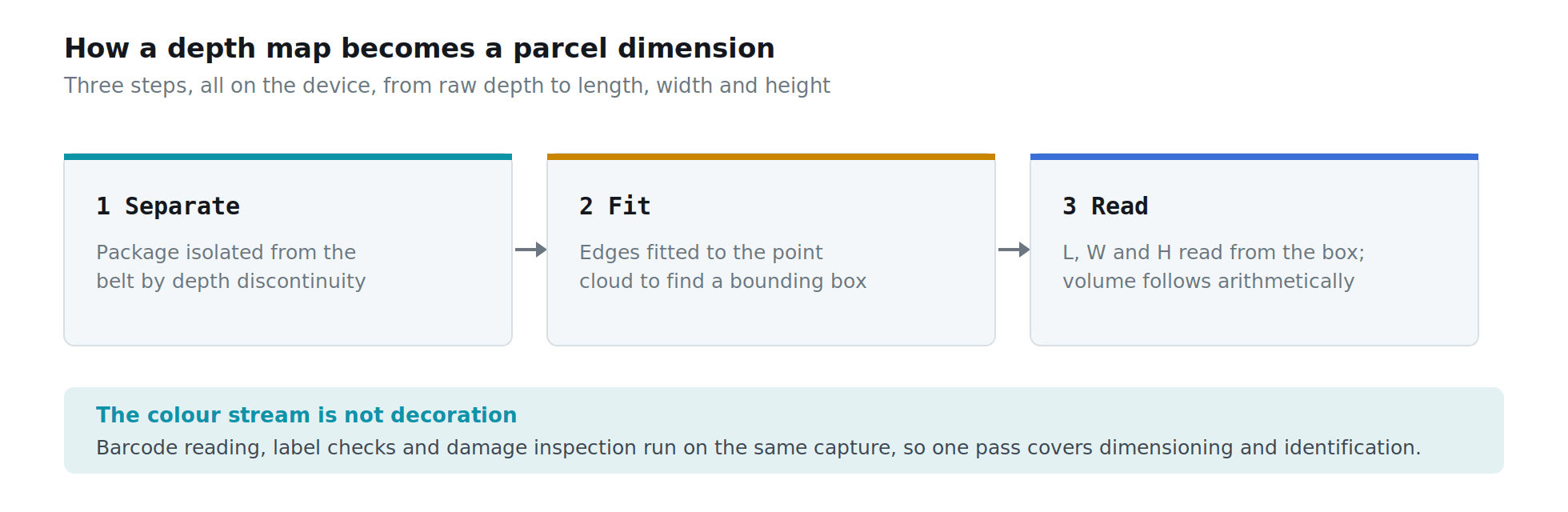
An RGBD volume measurement camera dimensions in three steps. The camera separates the package from the background plane by depth discontinuity. Edges are fitted to the isolated point cloud to find the bounding box. Length, width and height are read from that box, and volume follows arithmetically.
Colour data is not decoration. Barcode reading, label presence checks and damage inspection run on the colour stream, so a single volume measurement camera covers dimensioning and identification in one pass rather than requiring a separate scanner station.
Active or Passive: Which Sensing Method Fits?
Active projection suits short-range parcel work; passive stereo suits long-range bulk material. The distinction decides accuracy far more than resolution does.
An active RGBD volume measurement camera projects a pattern onto the object and reads the deformation, which produces reliable depth on plain cardboard and matte poly bags where a passive sensor finds no texture to match. A passive stereo unit relies on natural surface texture and reaches much greater distances, which suits bulk piles and vehicle loads rather than individual parcels.
| Model | Method | Baseline | Measuring range | Best suited to |
|---|---|---|---|---|
| PEA020-800-Y80 | Active | 80 mm | 0.6-3.0 m | Small parcels, sorting chutes |
| PEA020-800-Y180 | Active | 180 mm | 0.6-3.5 m | Mixed parcel sizes |
| PEA020-800-Y450 | Active | 450 mm | 1.5-4.5 m | Pallets and large cartons |
| PEP020-800-Y450 | Passive | 450 mm | 1-30 m | Bulk material, vehicle loads |
Source: Pyroglaux RGBD volume measurement product specifications.
How Accurate Is a Volume Measurement Camera?
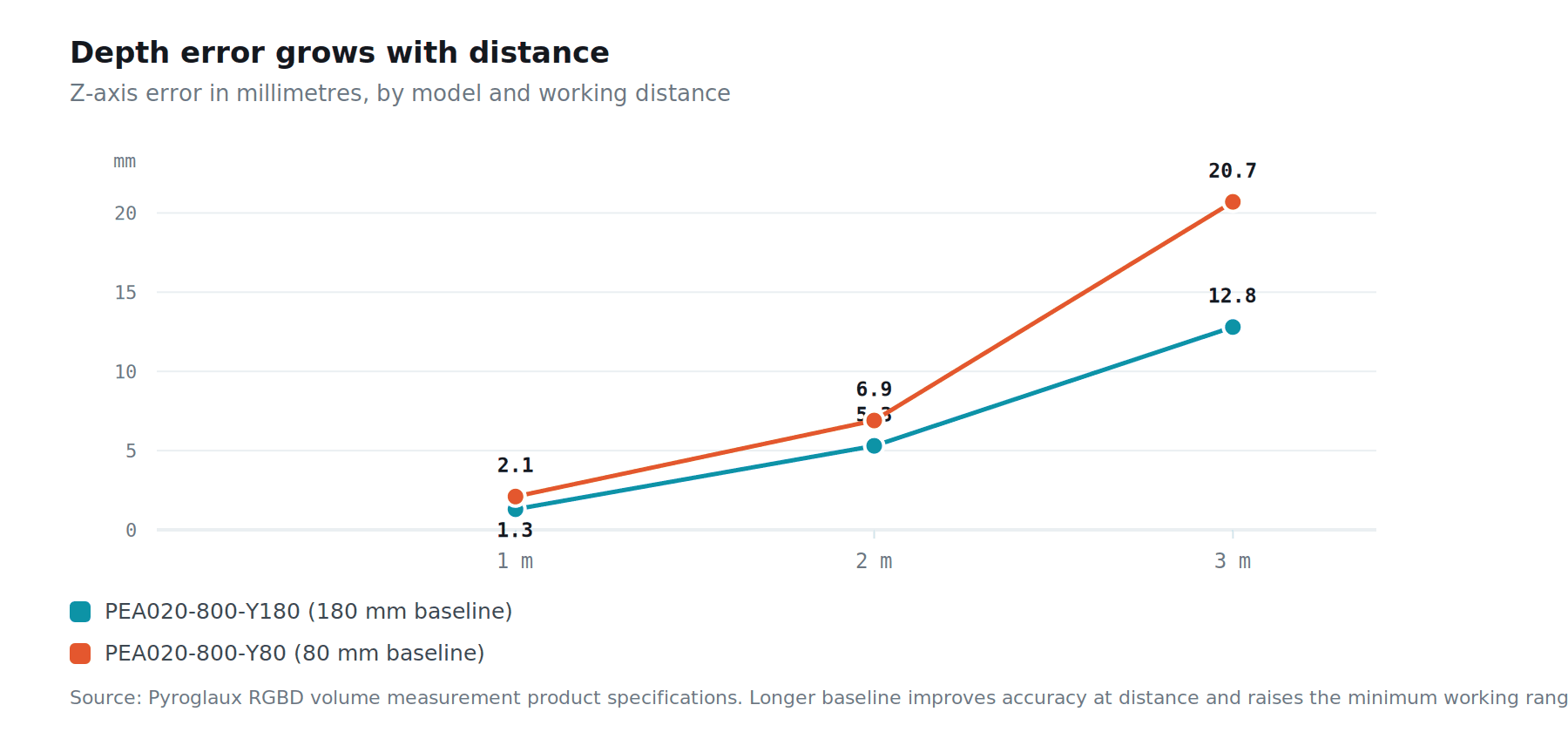
Depth accuracy degrades with distance, so the honest specification states error at several ranges rather than quoting one headline figure. A camera accurate to a millimetre at one metre is not accurate to a millimetre at three.
| Model | Z-axis error at 1 m | at 2 m | at 3 m |
|---|---|---|---|
| PEA020-800-Y180 | 1.3 mm or better | 5.3 mm | 12.8 mm |
| PEA020-800-Y80 | 2.1 mm or better | 6.9 mm | 20.7 mm |
| PEA020-800-Y450 | 2.1 mm at 1.5 m | 5.1 mm at 3 m | 18.1 mm at 4.5 m |
| PEP020-800-Y450 (passive) | 2% or better at 10 m | 6% at 30 m | - |
Source: Pyroglaux RGBD volume measurement product specifications. Confirm figures for a specific model against the datasheet before writing them into a tender.
Longer baseline improves accuracy at distance and worsens minimum working range, which is why the 450 mm unit starts at 1.5 m while the 80 mm unit works from 0.6 m. Mounting height is therefore a specification input, not an installation afterthought.
Static or Dynamic: Does the Parcel Stop?
A static volume measurement camera can average several frames; a dynamic one on a moving conveyor has a single chance per parcel. Frame rate is what separates the two.
Units running 1280x800 at 25 fps suit conveyor work, where a parcel crosses the field of view in a fraction of a second. Higher-baseline models running the same resolution at 8 fps suit a weighing station where the operator places a package and waits for a reading.
Global shutter matters more than most buyers expect on dynamic lines. A rolling shutter skews a moving object, and a skewed object measures larger than reality, which turns a sensor error into an overcharge on every parcel.
Where Does the Measurement Data Go?
Gigabit Ethernet carries colour and depth off the device, and the dimensioning result joins the warehouse system as a record per parcel. Integration follows the same pattern as any vision device: a structured payload rather than a proprietary file.
Four systems normally consume parcel dimensioning output. The warehouse management system stores dimensions against the parcel record. The sorter uses volume to choose a chute or a container. Freight rating applies the carrier's dimensional weight formula. Load planning packs vehicles from real dimensions rather than product-master estimates.
Storing the raw dimension triple rather than only the computed volume is worth the extra column. A future carrier contract with a different dimensional factor can be recalculated from length, width and height, while a stored volume figure cannot be unpicked.
What Does an RGBD Volume Measurement Camera Not Solve?
Three limits are worth stating before a pilot, because each one surprises teams that expected a universal answer.
Highly reflective and transparent packaging defeats parcel dimensioning on any structured-light sensor; shrink-wrapped pallets and clear poly bags need testing with real samples rather than assumption. Soft bags have no single true dimension, so the system reports a bounding box that depends on how the bag settles. Overlapping or touching parcels on a conveyor need separation upstream, because a dimensioner measures what it sees as one object.
None of the three is a reason to avoid automated dimensioning. Each is a reason to run a sample trial with the actual mix of packaging before committing to a line-wide rollout.
FAQ About RGBD Volume Measurement
How fast can an RGBD volume measurement camera measure a parcel?
Dynamic models capture at 25 frames per second, which is enough for normal conveyor speeds. The limiting factor is usually parcel separation on the belt rather than sensor speed. Static stations are slower by design because an operator places and removes each package by hand.
Does the camera need a barcode scanner as well?
Not always, because the colour stream supports barcode reading alongside dimensioning. Whether one device covers both depends on label placement and print quality. Sites with labels on unpredictable faces normally keep a dedicated scanner array and use the volume measurement camera for dimensions only.
Can one camera measure both small parcels and pallets?
No, and baseline is the reason. A short-baseline unit is accurate close up but cannot reach pallet height; a long-baseline unit reaches further but has a minimum working distance above the height of a small parcel. Mixed operations normally run two stations rather than one compromise device.
What accuracy do carriers require for dimensional weight billing?
Certification requirements vary by country and by carrier, and legal-for-trade approval is a separate process from the sensor specification. A camera quoting a few millimetres of error is technically adequate for internal use; billing a third party usually requires an approved and periodically verified system. Confirm the local requirement before assuming a sensor specification is sufficient.
How is the system installed on an existing conveyor?
The volume measurement camera mounts overhead at the specified working distance, with the belt surface as the reference plane. Calibration establishes that reference so the sensor knows where the belt is and treats anything above it as an object. Vibration isolation matters, because a mount that shifts over months moves the reference plane and biases every subsequent reading.
Can the same sensor family be used for people counting?
The depth technology is shared, but the models are tuned differently. Counting devices optimise for wide coverage and person separation at doorway heights; volume measurement models optimise for millimetre depth precision over a small area. Sites needing both use the appropriate device for each task rather than one unit for both.
Next Steps
Pilot parcel dimensioning on the real packaging mix first, including the awkward cases: shrink wrap, poly bags and irregular shapes. Measure a set of parcels by hand, compare against the sensor, and only then size the rollout.
Pyroglaux supplies active and passive RGBD volume measurement cameras with gigabit Ethernet, global shutter and full specifications on request. Request the datasheet set and a sample unit, or see the wider 3D vision range.