



Electronic Shelf Label (ESL) vs. People Counting System: Market and Value Comparison
2024-12-11 22:08The people counting system market and the electronic shelf label market both serve retail automation, but the two answer opposite questions: a people counter measures who came in, while an electronic shelf label controls what the shelf says. Retailers with one budget and two proposals need to know which question their store cannot currently answer.
Both retail automation categories grow at double digits, so market growth alone cannot decide the order of investment. Sequencing has to come from what each system changes on the shop floor.
How Fast Is Each Market Growing?
Both markets grow at double digits, and electronic shelf labels grow faster from a larger base. Grand View Research values the electronic shelf label market at USD 2.1 billion in 2025, forecasting USD 7.3 billion by 2033 at a CAGR of 17.4% across 2026-2033.
The people counting system market is smaller and slightly slower. The same research house puts global value at USD 1.3 billion in 2024, forecasting USD 2.6 billion by 2030 at a CAGR of 13.7% across 2025-2030.
| Measure | Electronic shelf labels | People counting systems |
|---|---|---|
| Market value | USD 2.1 bn (2025) | USD 1.3 bn (2024) |
| Forecast | USD 7.3 bn by 2033 | USD 2.6 bn by 2030 |
| CAGR | 17.4% (2026-2033) | 13.7% (2025-2030) |
| Unit count per store | Hundreds to thousands | One to a few dozen |
| Primary buyer | Grocery, pharmacy, DIY | All formats |
Source: Grand View Research, Electronic Shelf Label Market Report and People Counting System Market Report. Figures were checked in August 2026; both reports are updated periodically.
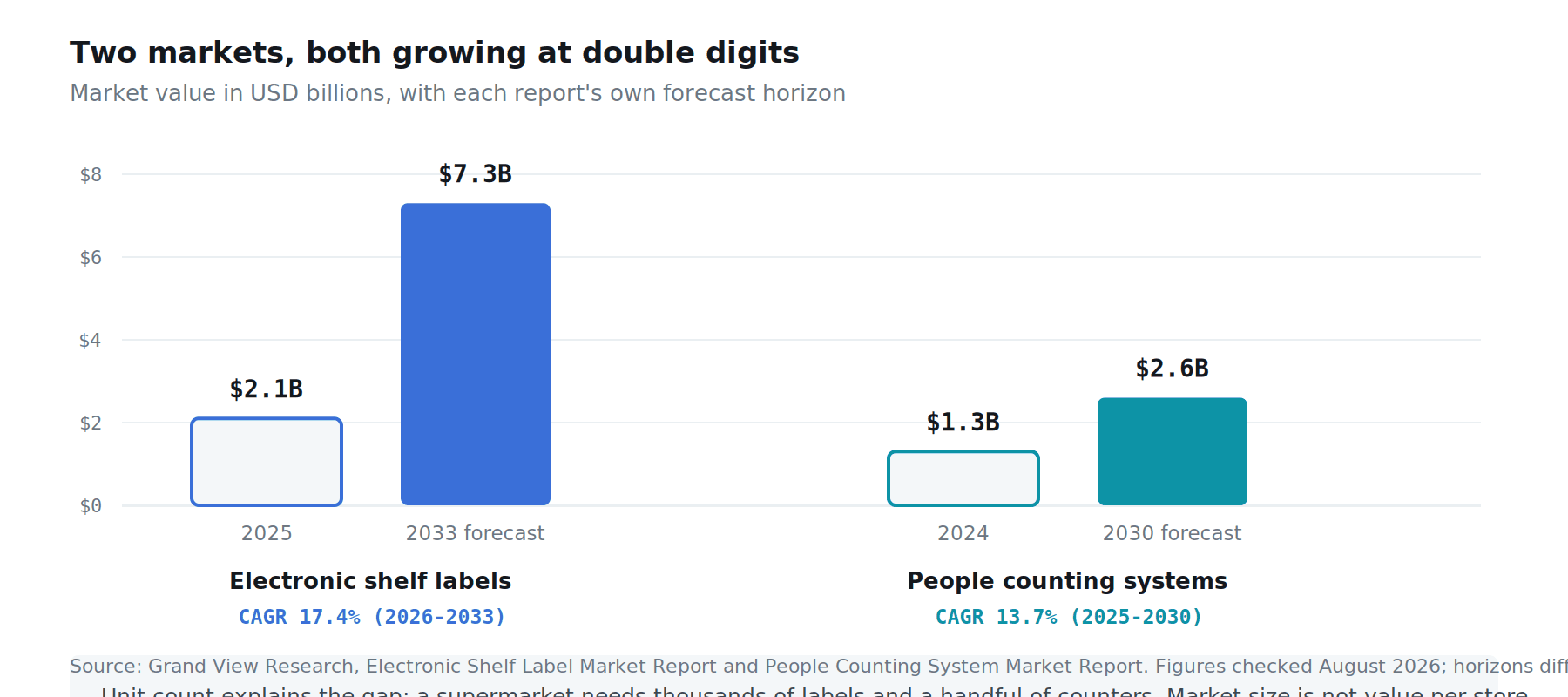
Unit count explains most of the size difference. A supermarket needs one label per facing, which runs into thousands of devices, while the same store needs a handful of counters at its entrances. Higher market value does not indicate higher value per store.
What Does Each System Actually Change?
Electronic shelf labels remove a manual task; people counting adds information that did not previously exist. The distinction matters when a retailer has to justify one before the other.
Electronic shelf labels replace printing and walking the aisles to swap price tickets. The saving is measurable in labour hours and in pricing errors avoided, and the benefit scales with how often prices change. A store repricing weekly gains far more than a store repricing quarterly.
Counters answer a question the till cannot: how many people came in and did not buy. Conversion rate, capture rate and hourly traffic are unavailable without a counter, no matter how good the point-of-sale reporting is. The output is diagnostic rather than a labour saving.
| Question | Answered by |
|---|---|
| How many visitors entered today? | People counting system |
| What share of visitors bought? | People counter plus till data |
| When should staff be on the floor? | People counting system |
| Is the shelf price correct right now? | Electronic shelf label |
| How long does a price change take? | Electronic shelf label |
| Which promotions ran at which price? | Electronic shelf label |
Which Should a Retailer Deploy First?
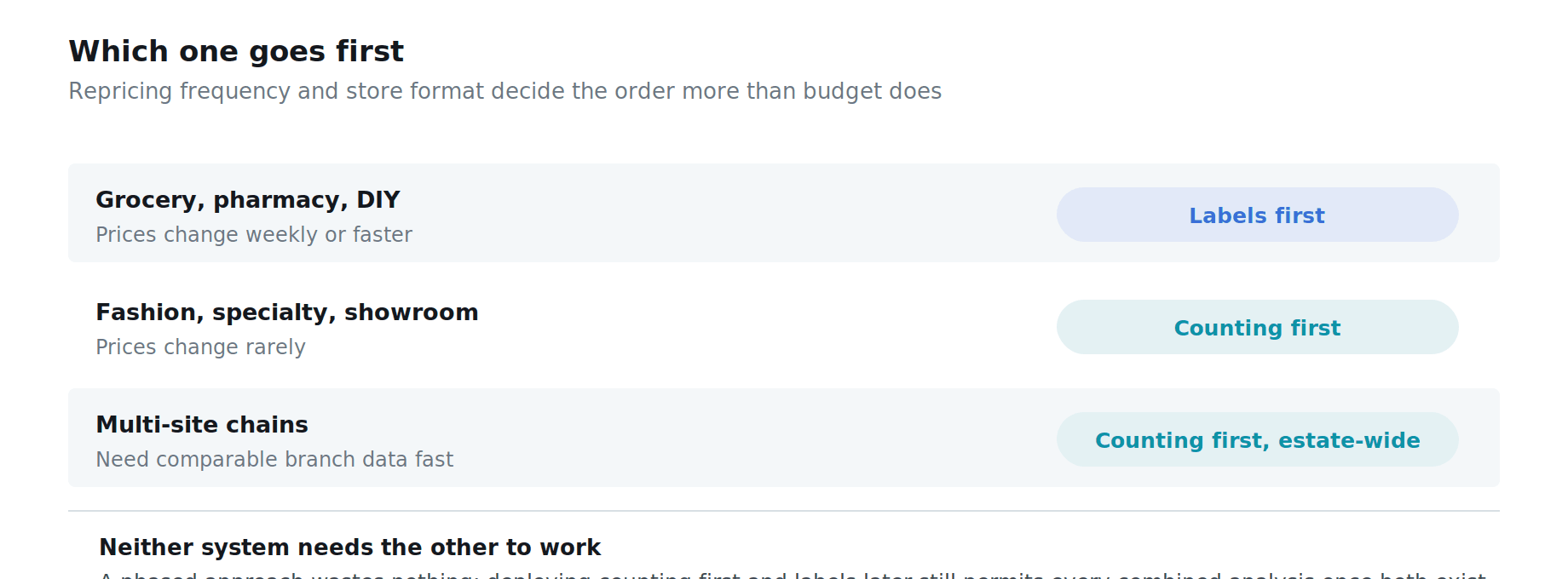
Format and repricing frequency decide the order more than budget does. Three patterns cover most decisions.
High-SKU, high-repricing formats such as grocery, pharmacy and DIY normally justify labels first, because the labour saving is continuous and large. Fashion, specialty and showroom formats reprice rarely and gain more from understanding traffic, so counting comes first.
Multi-site retail automation programmes have a third consideration. Counting hardware is cheap enough per store to roll out across an estate quickly, which produces comparable branch performance data within a quarter. Labels cost more per store and roll out slowly, so the estate-wide picture arrives much later.
Do the Two Systems Work Together?
The combination is more useful than either alone, because traffic data gives pricing decisions a denominator. A price change measured only in units sold ignores whether footfall changed at the same time.
Three joins are worth building. Conversion against price change separates a pricing effect from a traffic effect. Traffic by hour against promotion timing shows whether a promotion reached the hours that were actually busy. Zone traffic against category performance identifies aisles that people walk past rather than into.
Neither system needs the other to function, so a phased approach costs nothing in wasted work. Deploying counting first and labels later still permits every join above once the second system arrives.
What Are the Practical Obstacles?
Each retail automation category has one obstacle that derails more projects than any technical limitation.
For labels, the obstacle is integration with the pricing master. A label network is only as correct as the system feeding it, and a retailer with inconsistent price data automates the inconsistency rather than fixing it. Data cleanup usually belongs before hardware.
For counting, the obstacle is trusting the number. A counter installed and then argued with produces nothing. A ten-pass walk test in each direction at commissioning settles the accuracy question early, and a four-week baseline before any tactic changes gives every later comparison something to sit against.
FAQ: Electronic Shelf Labels and People Counting Systems
Which is cheaper to deploy in one store?
People counting, by a wide margin, because unit count differs by orders of magnitude. One entrance needs one sensor; one supermarket aisle needs hundreds of labels. Comparing quoted device prices without comparing device counts produces a misleading budget.
Does the people counting system market include software?
Yes, the category covers sensors and the analytics layer around them. Buyers should still check whether raw counting data is available without a subscription, since some vendors gate the data behind an annual platform fee while others publish an open interface with the hardware.
Can electronic shelf labels measure customer behaviour?
No, electronic shelf labels display a price and report their own status. Some systems add locator features that help staff find products, but no shelf label records how many shoppers passed the shelf. Behaviour measurement requires a sensor watching the space, not a device on the shelf edge.
How long does each system take to install?
A counter takes under an hour per entrance; a label rollout takes days to weeks per store. Label deployment involves mounting every facing and mapping each label to a product record, and the mapping step, not the mounting, is usually what determines the schedule.
Which delivers measurable results sooner?
Labels show a labour saving immediately; counting needs four weeks before the data supports a decision. Counting output is a baseline first and an insight second. Retailers expecting immediate answers from a counter in week one are measuring noise.
Are the market figures in this article current?
Figures were checked against Grand View Research in August 2026 and supersede earlier estimates. Market research houses revise forecasts periodically and different houses publish different figures for the same category, so verify against the current report before using any number in a business case.
Where to Start
A retailer who cannot state last month's conversion rate has a measurement gap, and a retailer whose staff still walk the aisles with a price gun has a labour gap. Whichever gap costs more each week is the one to close first.
Pyroglaux supplies 3D people counting sensors with an open data interface and no mandatory subscription. See the people counting range, read the footfall counter buyer's guide, or request a quotation.