



People Counting System: How to Choose for Retail and Public Spaces
2026-08-29 19:47A people counting system is three things bought together: sensors at the doors, a platform that stores and reports the counts, and an interface that moves the data into whatever else the organisation runs. Choosing badly usually means choosing on sensor accuracy alone and discovering the platform or the interface is the part that does not fit.
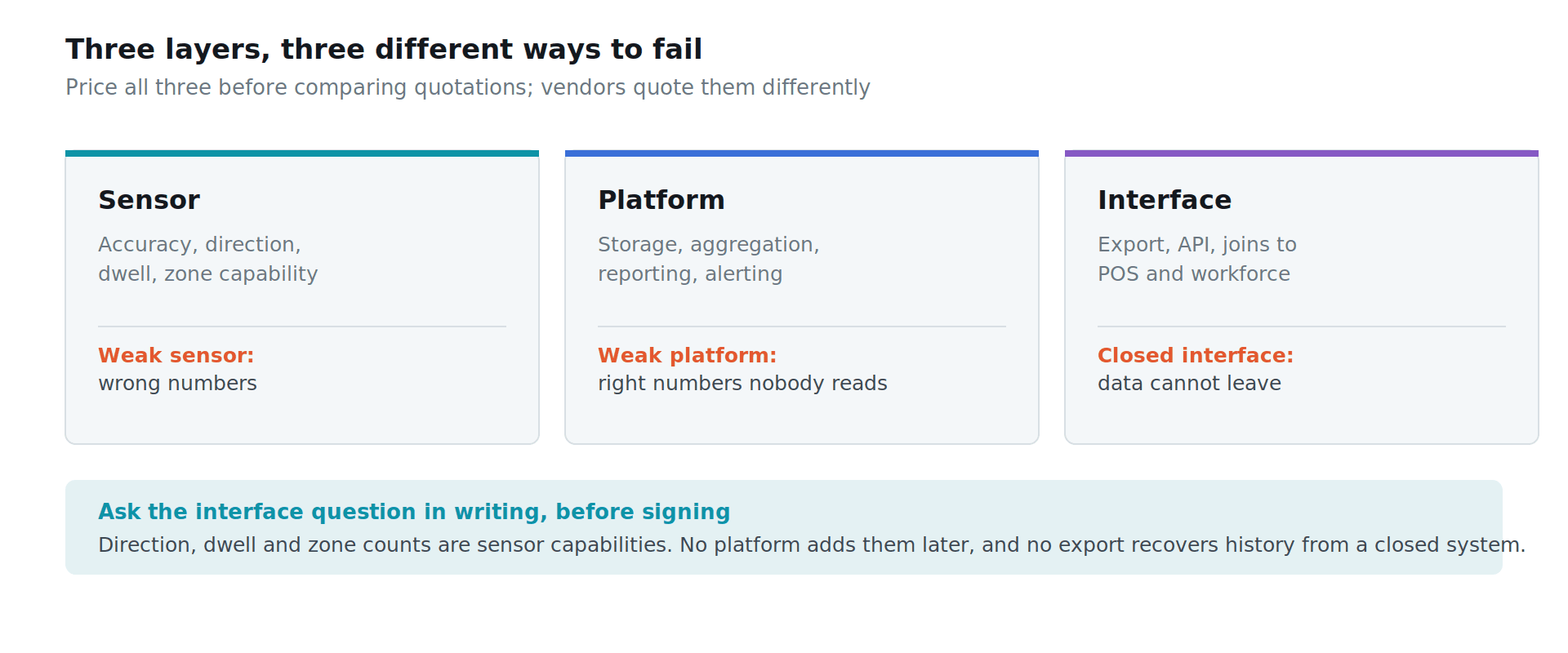
The three layers of a people counting system fail differently. A weak sensor produces wrong numbers. A weak platform produces right numbers nobody can read. A closed interface produces right numbers that cannot leave the vendor's dashboard.
What Are the Three Layers of a People Counting System?
A people counting system is sensor, platform and interface, and a buyer should price all three before comparing quotations. Vendors quote them differently, which is what makes like-for-like comparison hard.
The sensor layer decides accuracy and what can be measured at all. Direction, dwell time and zone counts are sensor capabilities; no platform can add them later. The platform layer decides how the numbers are stored, aggregated and displayed, and whether history survives a device swap.
The interface layer decides who owns the data. An open HTTP interface means the counts can go anywhere; a closed platform means the counts live where the vendor put them, and leaving later means leaving the history behind.
Which Sensor Technology Should the System Use?
People counting system technology follows the hardest condition at the door, not the average condition. A system specified for a quiet Tuesday fails on the Saturday it was bought for.
| Technology | Accuracy at a busy door | Direction | Dwell | Typical use |
|---|---|---|---|---|
| Infrared beam | Low, merges people | Limited | No | Small shop, low traffic |
| Thermal | Medium | Yes | Limited | Privacy-sensitive, low light |
| Single-lens video | Medium, light-dependent | Yes | Yes | Existing CCTV reuse |
| 3D stereo depth | High, separates by height | Yes | Yes | Most new deployments |
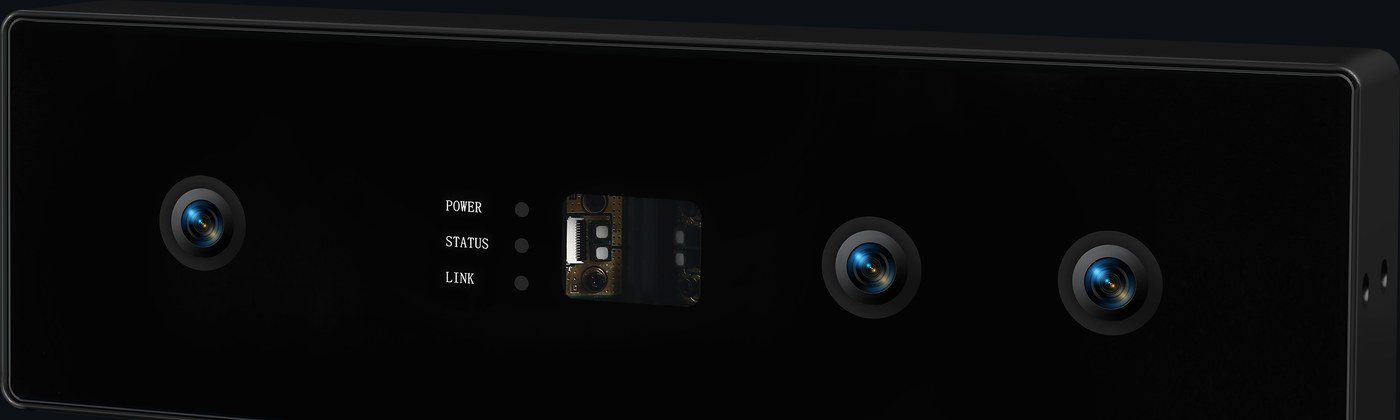
Pyroglaux 3D units are specified in the 95-99% band depending on model and mounting. Retail-grade devices are rated at 98% or better with a 100 degree by 70 degree field of view, mounted 2.2-6.0 m and covering 1.2-5.5 m. Vehicle-grade devices sit at 95-96% under boarding conditions. Confirm the figure for a specific model against the datasheet.
How Does Scenario Change the Specification?
Mounting height and field of view are set by the building, so the site survey precedes the model choice. The same people counting system covers very different rooms with different devices.
| Scenario | Mounting height | Field of view | Accuracy class |
|---|---|---|---|
| Retail entrance | 2.2-6.0 m | 100 x 70 degrees | 98% or better |
| Zone and heat mapping | 1.9-3.2 m | 140 x 115 degrees | 98% or better |
| Bus door | 1.9-3.5 m | 140 x 120 degrees | 96% or better |
| Minibus door | 1.5-1.9 m | 140 x 115 degrees | 95% or better |
| Metro door | 1.9-3.0 m | 140 x 120 degrees | 95% or better, infrared fill |
Source: Pyroglaux counting sensor specifications.
Wide entrances are the case people counting system buyers most often underestimate. Coverage scales with height, so a 4 m doorway may need a higher mount rather than a second device, and a low ceiling over a wide door may need two units with a configured overlap.
What Should the Platform Layer Actually Do?
Six capabilities separate usable people counting analytics from a chart that impresses in a demo. Each one is worth asking about with a specific question rather than a feature name.
People counting analytics needs hourly granularity, not daily, because staffing decisions live inside the day. Same-weekday comparison built in, since week-on-week is the only comparison that controls for weekday shape. Multi-site roll-up, so branches compare on conversion rather than raw sales.
Data export without a support ticket. History retained when a device is replaced, which is a question about how the platform keys its records. Alerting on device silence, because a counter that stops reporting looks identical to a quiet day until someone checks.
The last one catches more organisations than any accuracy issue. A dead sensor produces a plausible zero, and a plausible zero enters the weekly report unchallenged.
How Open Is the Interface?
Ask whether raw counts are available over a documented interface without a subscription, and ask before signing rather than after. The answer determines whether the counting data can ever join anything else.
A workable interface returns structured events over HTTP with a documented schema: an index, a timestamp, an event type and a dwell duration, retrievable by polling or delivered to a webhook. Devices in the Pyroglaux range expose exactly that on a fixed port with signed requests, and buffer roughly three days locally so a network outage delays data rather than losing it.
Three integrations justify asking. A customer counting system that cannot export is a dead end. Point-of-sale joins produce conversion rate. Workforce systems consume the hourly curve for rota planning. Building systems use live occupancy for capacity control. None of the three is possible if counts stay inside a closed dashboard.
Developers can review the people counting software and API integration guide for the data model and a first working request.
What Does a People Counting System Cost to Run?
People counting system pricing hides in the recurring line and the cabling, not the device price. Three questions expose the real figure.
Is there a mandatory annual platform fee, and does the hardware still function if the fee lapses? Is Power over Ethernet available, since PoE removes a socket and an electrician from every mounting point? What is the warranty and the replacement path, because a failed counter at a main entrance is a gap in the history rather than an inconvenience.
Market direction favours people counting system buyers. Grand View Research valued the global people counting system market at USD 1.3 billion in 2024, forecasting USD 2.6 billion by 2030 at a CAGR of 13.7% across 2025-2030. Falling device cost is why open interfaces are becoming a purchasing requirement rather than a differentiator.
How Should Accuracy Be Verified at Handover?
Walk the doorway a known number of times and compare the count, before the system is trusted with anything. Ten controlled passes in each direction exposes direction errors, event-type mapping and height-filter settings in one exercise.
Any mismatch at this stage is nearly always a configuration problem rather than a hardware fault. The counting line may sit in the wrong place, the height filter may exclude adults or admit trolleys, or the mounting height entered in setup may not match reality.
Once the walk test passes, leave the configuration alone for four full weeks. A baseline built on the same weekday pattern is what makes every later change measurable, and adjusting settings mid-baseline destroys the comparison.
FAQ About Choosing a People Counting System
How many sensors does a people counting system need per site?
One per entrance and exit used by the public, at minimum. Covering only the main door produces a running occupancy figure that drifts upward all day, because people leave through doors the system cannot see. Zone counting is a later phase, added once the entrance total is trusted.
Can a people counting system reuse existing CCTV cameras?
Sometimes, and the result is usually worse than a purpose-built sensor. Security cameras are mounted for face visibility at an angle, while counting wants an overhead view. Reuse saves hardware cost and typically loses several percentage points of accuracy, which matters most at exactly the busy doors where the data is needed.
Does the system work without an internet connection?
Counting continues on the device regardless of network state. Devices buffer roughly three days locally and forward the backlog on reconnection. A system that stops counting when the network drops is one where the counting happens in the cloud rather than on the sensor, which is worth establishing early.
How long does deployment take?
Under an hour per doorway once cabling is in place. Cabling and access arrangements set the schedule, not the sensors. A single-site rollout is usually a day; a multi-site estate is limited by installer availability rather than by anything technical.
What is the difference between a people counting system and a footfall counting system?
A footfall counting system and a people counting system describe the same category, with footfall more common in retail and people counting more common in transport and venues. Both refer to sensors plus a reporting layer, and footfall counting system specifications are read the same way. Neither term guarantees a particular technology, so compare specifications rather than product names.
Can counts be trusted for capacity compliance?
Only with every entrance and exit instrumented and a daily reset. Occupancy is entries minus exits, so one uncounted route biases the total in the unsafe direction. A scheduled reset at opening clears accumulated drift so each day starts from a known zero.
Getting Started
Survey the doors before shortlisting people counting systems, ask each vendor the interface question in writing, and plan a walk test into the handover. A people counting system chosen on those three steps rarely needs replacing for the reasons buyers worry about.
Pyroglaux supplies people counting systems built on 3D stereo sensors with PoE, an open documented interface and no mandatory subscription. See the counting sensor range, read the footfall counter buyer's guide, or request a site survey.